A sewer scope is a plumber pushing a camera on a cable through the pipe that carries everything from the house to the street. A general home inspection usually doesn't include it, so you book it separately. Our report engine suggests one for any house built through 1973, the era of cast iron drain lines, and puts the cost at $300 – $500. What you get back is a video and a written log. Here's how to read them, and where they stop.
Before the camera goes in
Two things decide how much of the line you'll actually see.
An access point. A push camera goes in through a cleanout, a capped pipe that opens into the sewer line. The 2006 research report on private sewer laterals we relied on (published by the Water Environment Research Foundation) says plainly that a camera "cannot be used" where there are "no accessible cleanouts or any other points of entry." If the house has no cleanout, ask the plumber where they plan to go in before you book.
A clear pipe. The same report says any blockage should be cleared first, and a line "infested with roots or has grease or debris" should be cleaned before the camera goes in. That isn't a rare step: one Oregon city that inspected laterals found cleaning necessary in about 90% of them. A scope run through a dirty line can stop short or hide what's under the debris, so ask whether cleaning is included in the price.
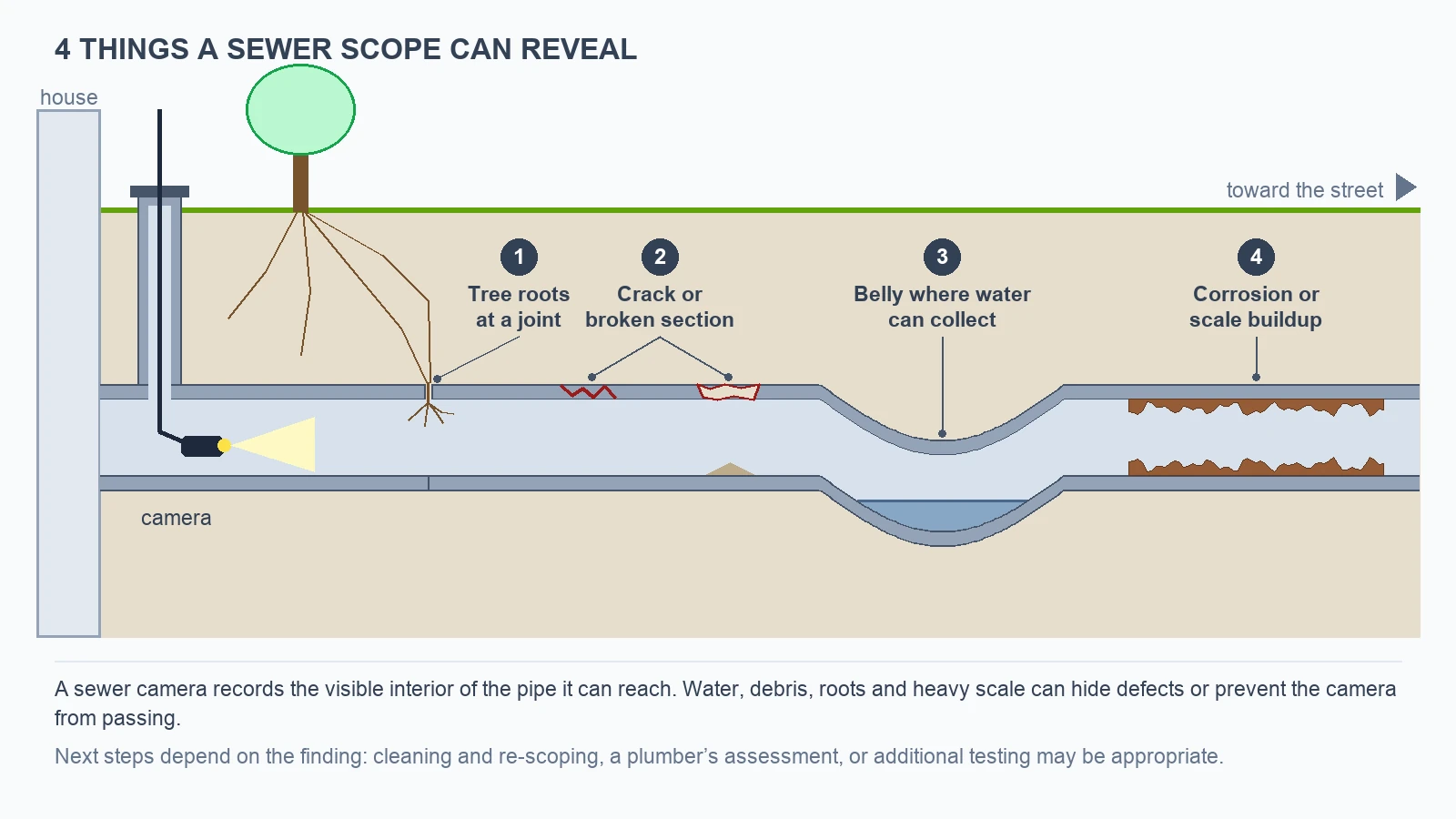
Free to use with credit (CC BY 4.0)
You can use this diagram on your own website, in an inspection report or in training material, including commercially. The one condition is credit to Before Regret as the source. License terms
Or download the image and credit it as “Diagram: Before Regret” with a link to this page.
1. Tree roots at a joint
What the camera can show. Roots tend to come in at the joints. Researchers describe them following the outside of the pipe "until they find a joint to enter," then pushing the joint further open. On video that looks like hair-thin strands at a joint, or a dense ball of roots filling the pipe. Inspectors grade the difference: in the standard defect codes the 2006 report lists, a fine root at a joint scores 1 and a root ball at a joint scores 4.
What it can't establish. A thick root mass hides the joint behind it. The camera can't tell you whether that joint is merely open or cracked as well until the roots are out of the way.
Follow-up. Ask for the line to be cleaned (root cutting or jetting) and then re-scoped, so you can see the joint itself. Then ask the plumber whether the joint needs a repair or only maintenance, and get the answer in writing with a price.
2. A crack or broken section
What the camera can show. Cracks, holes, pipe that's out of round, collapsed sections, and joints that have opened or slipped out of line. A break where soil is visible through the pipe wall, or a collapse, sits at the top of the defect scale, scoring 5.
What it can't establish. Some cracks don't show at all. The report notes laterals "may have fine cracks that do not show during the CCTV inspection but leak at higher groundwater levels during wet weather." A camera also catches active leaks but only possibly inactive ones, while a pressure test finds both. A clean video is good news, not proof the line is tight.
Follow-up. A visible break is a repair question. Our engine puts a spot repair at $1,500 – $5,000 and a full replacement at $4,000 – $15,000+. A plumber's quote on this line replaces those ranges. If the house is older and the video is clean but the line is original, it's reasonable to ask whether a second test is worth doing. The report notes that sewer agencies usually combine methods for exactly this reason.
3. A belly holding wastewater
What the camera can show. A belly, or sag, is a low spot in the line where wastewater sits instead of draining away. The camera sees the standing water and the pipe dipping into it. Some cities grade sags by severity. San Mateo, California, scores a shallow sag (under 30%) a 3, a medium one (30% to 50%) a 4, and a deep one (over 50%) a 5 on its lateral inspection form.
What it can't establish. Why the pipe sank. The report warns that if a soft zone of soil sits under a sag, replacing the pipe along the same line can deepen it. That's a question about the ground, not the pipe, and the video can't answer it.
Follow-up. Ask how the plumber would fix it, because method matters here. A liner won't remove a sag, and pipe bursting follows the old alignment. Our guide to a sewer line belly found during inspection goes through the repair options and the questions to ask.
4. Corrosion and internal scale
What the camera can show. Rough, lumpy buildup on the inside wall, which the report calls encrustation (dissolved salts deposited on the pipe walls). In old, corroded pipe that internal scale can narrow the bore a long way. The report describes corroded pipes "so much reduced in diameter" that normal cleaning isn't enough to get the camera through.
What it can't establish. A camera records the scale it can see. It doesn't tell you how much sound pipe is left behind it, and if the camera can't pass, the rest of the line simply goes unseen.
Follow-up. If scale stopped the camera, the report should say where. Ask whether descaling and a second scope are possible, or whether the plumber is already quoting replacement. Our guide to cast iron sewer pipe damage covers what that decision usually turns on.
What to ask for in the report
- The video, not just a summary. You or a second plumber can watch it again.
- A written log with distances. The report describes CCTV logs that record each defect's location and position around the pipe. Roots at a stated distance from the cleanout are something a quote can be written against. "Some roots" isn't.
- How far the camera got. If it stopped before the street, why: no access, a blockage, standing water or scale. Standard practice is to keep the water level "as low as possible" during a camera inspection, so a flooded line is a reason to schedule a second look, not a pass.
A single bad finding isn't automatically a reason to walk away. What it does is give you a specific, priced question to put to the seller before your inspection period ends.
How we checked this
- What we read, on 18 October 2026: the Water Environment Research Foundation's 2006 report Methods for Cost-Effective Rehabilitation of Private Lateral Sewers (Sterling and others), hosted by Chicago's Metropolitan Water Reclamation District. Its chapter on inspecting laterals gives the camera's strengths and limits, the cleaning and access requirements, and a defect-code list. We also read the City of San Mateo's sewer lateral inspection form for the sag grades.
- Our own work: the cost ranges and the through-1973 cutoff come from our report engine. We drew the diagram from the report's descriptions of each defect.
- What we didn't check: the defect scores above come from a 2005 code list printed in that report. NASSCO's current inspection codes are in a paid manual we didn't read, so today's scores may differ. Requirements for when a scope is needed, and who owns which part of the line, vary by city.