A belly is a sag in the sewer line: a low stretch where the pipe dips instead of sloping steadily toward the street. Water and waste settle in it rather than flowing through. Camera inspections are partly done to catch this. A 2006 Water Environment Research Foundation report on repairing private sewer lines lists one of their purposes as finding "any existing sags or misaligned joints that can promote buildup of material in the pipes."
If a sewer scope on the house you're buying found one, don't settle on a fix yet. First work out how big the problem is, then how to fix it, then who pays.
How serious is this belly?
There's no single national scale, but some cities that require sewer-line inspections grade sags. The City of San Mateo, California is a clear example. Its official Sewer Lateral Inspection Form lists "Sale of Property" among the reasons for an inspection, and it scores a sag as a structural defect:
| Sag on San Mateo's form | Grade |
|---|---|
| Shallow (<30%) | 3 |
| Medium (30% - 50%) | 4 |
| Deep (> 50%) | 5 |
A line fails if it has any grade 5 structural defect. It also fails if all its defect grades together add up to thirteen (13) or more. So a deep sag fails the line on its own, while a shallow one only adds to the total alongside cracks, roots or debris. The form doesn't define what the percentage measures, so ask your inspector to describe the sag in those terms and say what the number refers to.
Your city may have no program like this at all. The grades are still a useful way to ask "how bad is it?" and get a specific answer.
The repair options, and which ones actually fix a sag
Leave it and keep it clean. A shallow belly that holds a little water may only need periodic cleaning. San Mateo's form lists jetting to remove debris as one kind of required work. The trade-off is ongoing maintenance, not a repair.
Spot repair. Digging up the low section and relaying it. Our report engine puts a spot repair at $1,500 – $5,000. Ask the contractor what drives their number: how deep the pipe is, how long the section is, and what sits on top of it.
Full replacement. Worth pricing when the belly is one of several problems along the line. Our report engine's figure is $4,000 – $15,000+.
Trenchless options, and their limit. Lining and pipe bursting avoid digging a trench. The 2006 report is blunt about sags, though:
- Lining: "The CIPP will not remove sags or curves in the existing pipe." The new liner follows the dip.
- Pipe bursting: the new pipe "follows the old pipe alignment." The report says bursting "does not remove sags," though it may smooth out abrupt ones, and adds that "significant sags cannot be removed."
- It can backfire: if there's soft ground under the sag, bursting can push the new pipe into it and deepen the sag. In one program the report describes, 15 laterals had to be replaced by open cut after bursting, because of sags or collapsed pipe.
So if a contractor quotes lining to "fix the belly," ask how the liner will change the slope. It won't.
Questions to ask before your deadline
Ask the inspector:
- Can I have the video file, with the distance from the cleanout to the belly marked?
- How deep is the sag, as a percentage, and what is that a percentage of?
- What's in it: standing water, debris, roots? Did anything else show up along the line?
- What's the pipe made of? An old cast iron line raises separate questions; see cast iron sewer pipe damage.
Ask the city or the sewer district:
- Who owns the line between the house and the main, and is any part of it the city's?
- Does the city require a lateral inspection or repair when a house is sold?
Ask the repair contractor:
- Will your method correct the slope, or only reline the existing pipe?
- Is a permit needed? Will you re-scope the line afterward to show the sag is gone?
- What does the warranty cover?
The same camera that shows a belly where water can collect can show three other problems along the line: tree roots at a joint, a crack or broken section, and corrosion or scale buildup narrowing the pipe. Our guide to what a sewer scope can reveal before you buy covers what the camera can and can't establish for each.
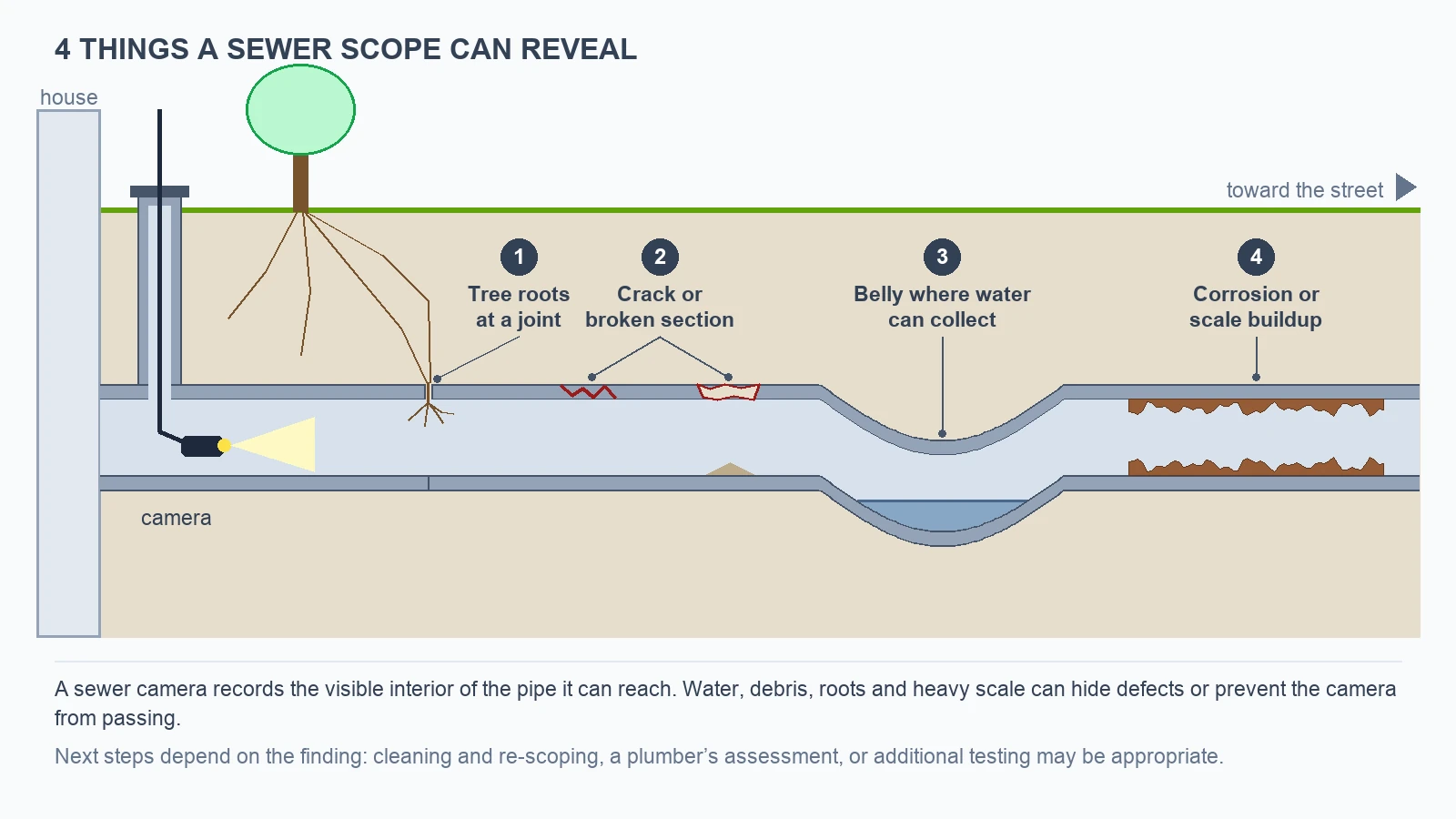
Free to use with credit (CC BY 4.0)
You can use this diagram on your own website, in an inspection report or in training material, including commercially. The one condition is credit to Before Regret as the source. License terms
Or download the image and credit it as “Diagram: Before Regret” with a link to this page.
Turning the scope into a number
A written finding plus a contractor's quote is what lets you ask for a repair or a credit. If you're still deciding whether to book a scope, our engine's figure is $300 – $500 for a camera scope, small next to the repair figures above.
If the seller won't move and the repair is large, when it's reasonable to walk away after an inspection covers how to think that through.