Failing to identify hidden polybutylene plumbing during home buying walkthroughs can lead to sudden internal water leaks and whole-home repiping costs shortly after closing. Because these pipes degrade from the inside out without showing obvious exterior wear, buyers who rely solely on quick visual checks often inherit significant financial liabilities.
Polybutylene was widely marketed as a low-cost, flexible alternative to traditional copper plumbing and was installed in millions of homes built from the late 1970s through the mid-1990s [CPSC]. Understanding where these pipes hide, what markings distinguish them, and why superficial checks can be misleading is essential for any buyer evaluating an older home.
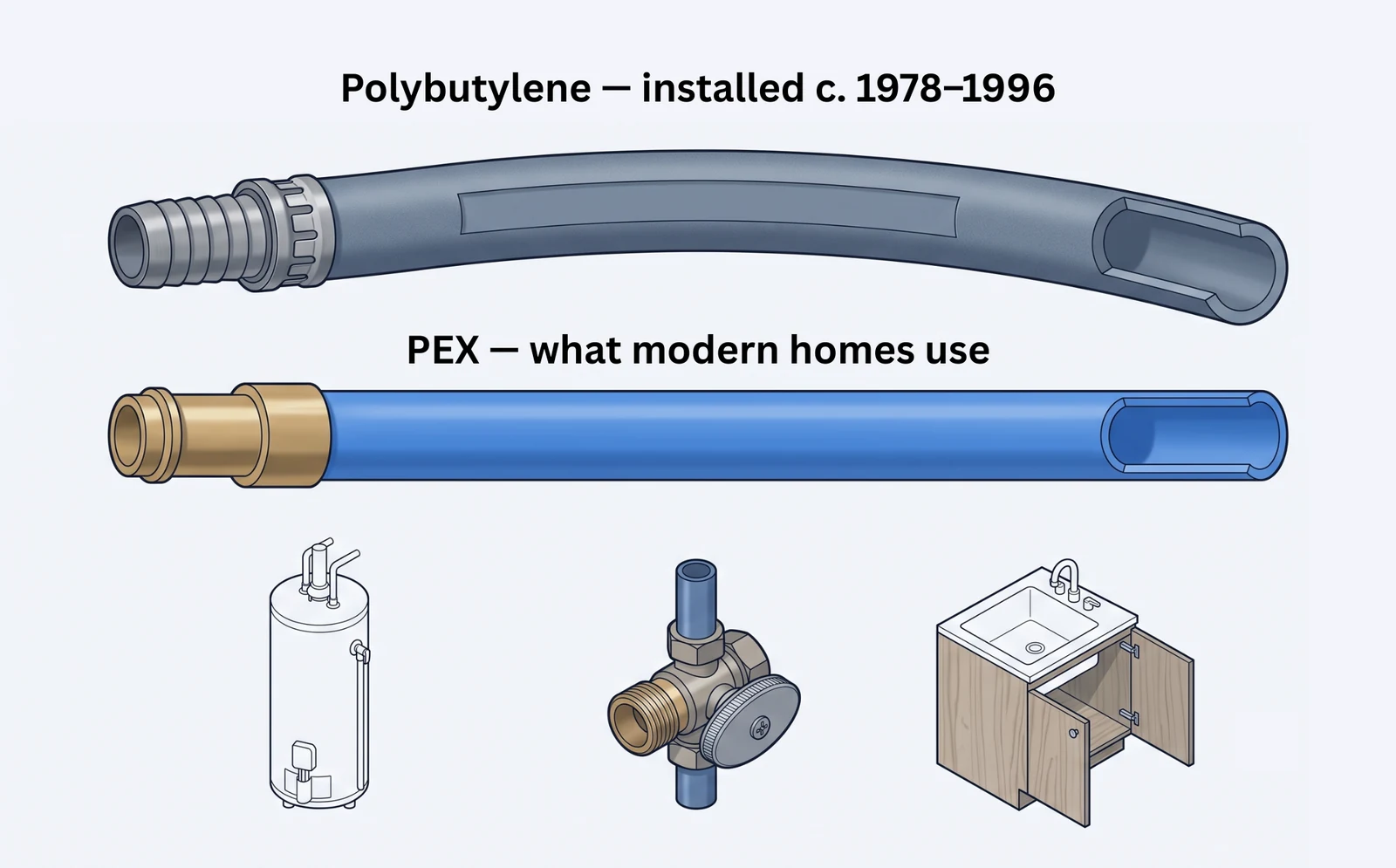
Free to use with credit (CC BY 4.0)
You can use this diagram on your own website, in an inspection report or in training material, including commercially. The one condition is credit to Before Regret as the source. License terms
Or download the image and credit it as “Diagram: Before Regret” with a link to this page.
Key Visual Characteristics of Polybutylene Pipes
Polybutylene is a form of plastic resin that was manufactured into flexible water supply piping. During a property walkthrough, identifying this material requires knowing its physical traits, markings, and typical connector types.
The pipe itself is a flexible, smooth plastic tube that generally ranges from one-half inch to one inch in diameter. Unlike rigid PVC or hard copper, polybutylene can be gently bent around corners, though installers also used angled fittings in tighter spaces.
Color is often the first visual indicator, though it is not definitive on its own:
- Grey: The vast majority of indoor polybutylene supply lines are dark or light grey.
- Blue: Commonly referred to in the plumbing trade as "Big Blue," blue polybutylene was used extensively for underground main water service lines running from the municipal meter to the house.
- Black or White: Less common in residential indoor applications, but black and off-white polybutylene pipes were occasionally installed in certain geographic regions.
To confirm whether a pipe is polybutylene, inspect the exterior surface for printed manufacture codes. Polybutylene piping is stamped with a repeating code along its length. Look for the designation PB2110 printed directly on the tubing. You may also see standards codes such as ASTM D-3309, which was the specific standard governing polybutylene hot- and cold-water distribution systems.
The fittings and crimp rings used to connect polybutylene sections offer additional clues. Installers used several types of connectors over the production lifespan:
- Copper or Aluminum Crimp Rings: Dark copper or grey metal rings crushed around the outside of the pipe to hold it onto internal plastic or metal fittings.
- Plastic Insert Fittings: Grey or black plastic elbows and tees secured with metal crimp rings.
- Brass or Copper Fittings: Threaded or crimped metal connectors, which were used more frequently in later installations after plastic fittings demonstrated high failure rates.
Where Polybutylene Hides in a Residence
During an initial walkthrough or open house, buyers do not have the option to open up drywall or dismantle cabinet bases. However, several accessible areas permit visual examination of exposed plumbing lines.
1. Around the Water Heater Inspect the supply lines connected to the top of the water heater tank. While local building codes often require metallic flex connectors directly adjacent to the water heater for fire safety, these transition fittings frequently connect to polybutylene pipes just a few inches into the wall or overhead ceiling joists. While you are at the tank, the temperature and pressure relief valve is the other water-heater item inspectors flag most often.
2. Underneath Sinks and Vanities Open the cabinet doors under kitchen sinks, bathroom vanities, and laundry tubs. Look at the supply lines coming out of the wall or floor that feed into the shutoff valves. Examine both the vertical riser tubes going to the faucet and the main pipe protruding from the wall structure.
3. Unfinished Basements and Crawl Spaces If the home has an unfinished basement or accessible crawl space, bring a flashlight to inspect the overhead floor joists. Plumbing supply runs are commonly routed along or through floor joists. Because these lines are entirely exposed in unfinished areas, they provide the clearest view of the home's primary supply network.
4. The Main Water Shutoff Valve Locate the main interior water shutoff valve, typically found in a basement, utility closet, garage, or near the front exterior wall. Inspect the pipe coming through the wall or concrete slab before it reaches the shutoff valve handle.
5. The Exterior Main Service Line Examine the water line where it enters the home from the ground outside or inside the water meter box near the street. Blue polybutylene was frequently used underground between the city connection and the house main valve.
The "Stub-Out" Trap: Why Visual Inspections Can Deceive
One of the most common pitfalls for prospective home buyers is relying exclusively on what is visible beneath bathroom and kitchen sinks. A buyer might look under every sink in the house, see clean copper or modern white PEX piping, and incorrectly assume the entire building has been updated.
This scenario often represents a partial repipe or a cosmetic "stub-out" modification. During minor bathroom renovations or local leak repairs, plumbers or homeowners frequently replace only the visible sections of pipe—the "stub-outs"—that extend from the drywall to the shutoff valve.
Behind the drywall, however, those newer copper or PEX sections may be connected directly to original polybutylene runs using push-fit or transition crimp fittings. The bulk of the home's plumbing infrastructure remains original polybutylene hidden inside walls, ceilings, and floor cavities.
Standard home inspection guidelines require inspectors to identify and report on visible supply piping materials [ASHI]. What leaves the house is treated differently from what enters it — a septic system is not part of a standard inspection and is booked separately. Because home inspectors do not perform invasive testing or cut open walls, a standard home inspection report may note copper under the sinks while the home retains concealed polybutylene lines throughout its framing.
The Failure Mechanism: Why Polybutylene Degrades Internally
Understanding how polybutylene degrades explains why visual inspection alone cannot determine the structural integrity of the pipe. Unlike iron pipes that rust from the outside or copper pipes that develop visible green corrosion spots, polybutylene deteriorates through internal chemical reactions.
Municipal water utilities treat drinking water with disinfectants like chlorine and chloramines to eliminate bacteria. When treated water flows through polybutylene pipes, these oxidants react chemically with the plastic polybutylene resin [CPSC].
This chemical interaction causes micro-fracturing along the inner walls of the pipe. Over time, these tiny internal cracks extend deeper into the pipe wall, embrittling the plastic and scaling away material from the inside.
Because this chemical degradation takes place entirely on the interior pipe surface, the outside of the pipe can look completely smooth, flexible, and clean right up until the point of failure. The pipe wall thins and loses tensile strength until normal household water pressure causes sudden splitting, micro-flaking at fitting crimps, or complete bursting.
Because internal micro-fracturing gives no external warning signs, the age of the installation and the presence of the material itself—rather than visible surface condition—are the primary risk factors.
Professional Evaluation: Steps Before Closing
If you suspect or confirm the presence of polybutylene piping during a home search, taking methodical evaluation steps before removing your inspection contingency can protect your investment.
Step 1: Hire a Licensed Plumbing Contractor While a general home inspector can flag visible polybutylene sections, a licensed plumber can perform a comprehensive plumbing system assessment. Plumbers can inspect less obvious access panels, evaluate water pressure levels, examine crimp connection integrity, and determine whether previous owners performed partial or complete repiping.
Step 2: Check Key Access Locations Ask your plumber to examine access panels behind tub surrounds, shower valves, and main line distribution manifolds. These access panels often reveal original piping connections that remain untouched during superficial room updates.
Step 3: Consult an Independent Insurance Agent Plumbing material directly affects property insurability and underwriting terms. Some property insurance carriers decline to issue standard homeowners policies for structures containing polybutylene supply lines, or they may impose higher deductibles and exclude water damage coverage resulting from pipe ruptures. Bringing your plumbing findings to an insurance agent early in the escrow process prevents unexpected coverage denials right before closing.
Step 4: Request Repair Credits or Full Repiping If polybutylene piping is present, obtain formal estimates from licensed plumbing contractors for a full structure repipe. Replacing polybutylene typically involves running modern materials like PEX or copper throughout the house, opening drywall, and making subsequent drywall and paint repairs. Having itemized, professional quotes gives you concrete documentation to negotiate repair credits or price concessions with the seller before final closing.
Polybutylene and Home Insurance: Why Carriers Decline
Polybutylene belongs to a small group of defects that can stop a policy outright rather than merely raise its price. For a buyer, that makes it a financing problem as well as a plumbing one: no binder means no mortgage, and the discovery usually happens late.
The discovery route is almost always the 4-Point inspection, which covers roof, plumbing, HVAC and electrical, and which carriers in constrained markets require on older homes. The timing is not a coincidence. Polybutylene was installed from the late 1970s through the mid-1990s, so every house that still has it is now old enough to trigger that inspection requirement automatically.
Carriers respond in one of three ways. Some decline new business outright. Some non-renew an existing policy once the piping is documented, unless the owner can show proof of replacement. Others will write the risk but attach conditions, typically a water damage exclusion for pipe rupture or a substantially higher deductible.
The published rules are stricter than most buyers expect. Citizens Property Insurance Corporation, Florida's insurer of last resort, states that dwellings 20 years old or newer with polybutylene piping may be eligible for coverage if there are no signs of leaks, unrepaired water damage, disrepair or hazards. Read alongside the installation dates, that window has effectively closed for original polybutylene: a house plumbed at the very end of the material's run is now past 30. The rule is one carrier's, in one state, and other markets are written differently — but it shows the shape underwriters use, which is age plus condition rather than condition alone.
Two practical consequences follow.
Settle the insurance question before your contingency expires, not after. Take the plumber's findings to an independent agent who represents several carriers and ask for a real quote on the address. An agent can tell you within a day whether the property is writable at all, which is information worth more than any estimate of what a repipe might cost.
A partial repipe may not satisfy an underwriter. This is where the stub-out problem described above becomes an insurance problem: carriers asking for proof of replacement generally mean the whole supply system, not the visible sections. Documentation of a full repipe by a licensed contractor, with the permit closed where the jurisdiction required one, is what restores insurability. A seller's assurance that the pipes "were replaced" is not.
Immediate Action Step for Home Buyers
If you are currently under contract on a home built between 1978 and 1995, locate the home's water heater and main shutoff valve during your next scheduled walkthrough or inspection period to look for grey or blue plastic lines stamped with PB2110. Immediately hire a licensed plumbing contractor to evaluate any visible plastic lines and verify whether concealed supply piping behind the drywall has been fully replaced or merely stubbed out with modern materials.