Discovering an original fuse panel during a home walk-through can delay your purchase or trigger an unexpected repair bill right before closing. If an insurance carrier refuses to write a policy because of an outdated electrical system, your lender will not fund your mortgage loan.
While fuse technology itself is not inherently defective, insurance companies view homes with an active fusebox as elevated risks. Understanding how underwriters evaluate these older components—and what options exist during contract negotiations—can keep your transaction on track.
Why Insurers Are Cautious About Fuse Panels
In the first half of the twentieth century, fuse panels were the standard method for distributing residential electricity. Fuses are simple sacrificial devices designed to melt and break the circuit when electrical current exceeds safe limits.
The primary issue insurers have with a fuse panel is not the basic physics of the fuse itself, but the age of the overall system and how modern households use electricity. Most fuse systems were installed when household power demands were a fraction of what they are today [NFPA].
When an older electric panel is pushed beyond its original design capacity, homeowners sometimes bypass built-in safety features to prevent fuses from continually blowing. Underwriters view these human workarounds and the natural aging of the equipment as significant fire hazards [CPSC].
The Three Main Risks That Trigger Insurance Refusals
Free to use with credit (CC BY 4.0)
You can use this diagram on your own website, in an inspection report or in training material, including commercially. The one condition is credit to Before Regret as the source. License terms
Or download the image and credit it as “Diagram: Before Regret” with a link to this page.
When an insurance carrier reviews a home inspection or 4-Point inspection report showing a fuse panel, underwriters typically focus on three distinct technical problems:
1. Over-Fusing Hazards
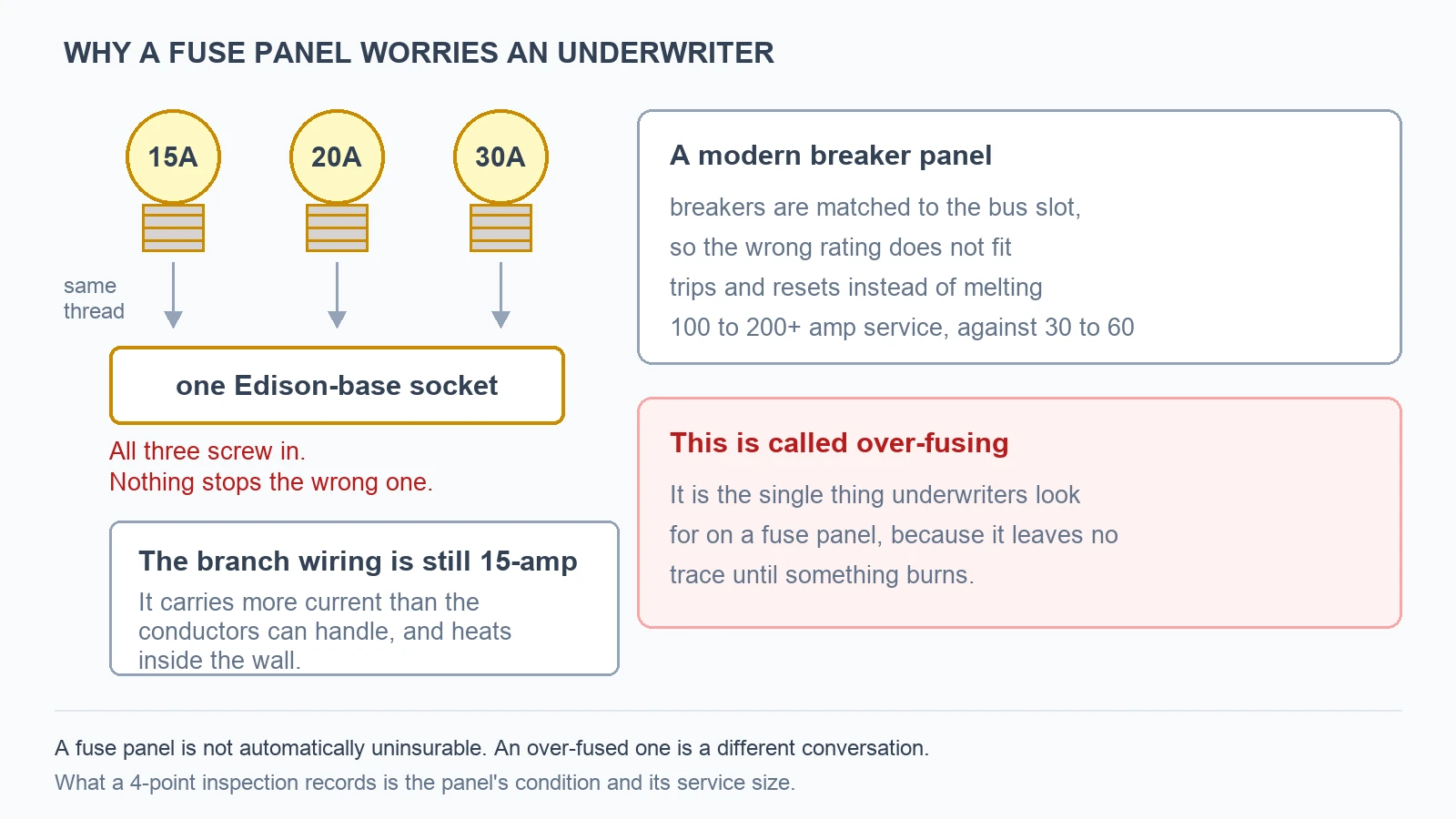
Standard screw-in fuses, known as Edison-base fuses, share the same thread size across different amperage ratings. A 15-amp circuit supplying standard light fixtures can easily accept a 20-amp or 30-amp fuse.
When residents repeatedly blow a 15-amp fuse due to heavy appliance use, they may install a higher-amperage fuse instead of reducing the electrical load. This practice, known as over-fusing, allows more current through the branch wiring than the copper or aluminum conductors can safely handle, generating extreme heat inside the walls before the fuse ever melts [NFPA].
2. Physical Modification and Bypassing
In extreme cases, inspectors find instances where fuses have been bridged using coins, foil, or copper wire to keep power flowing through overloaded circuits. This completely eliminates the overcurrent protection for that circuit, creating an unmitigated fire risk that no standard insurance company will knowingly cover [ASHI].
3. Insufficient Overall Amperage
Homes built with original fuse boxes frequently have total service capacities of 30, 60, or 80 amps. Modern residential electrical standards typically require a minimum of 100 to 200 amps to safely handle HVAC units, kitchen appliances, high-draw electronics, and electric vehicles.
An undersized power panel forced to supply modern appliances operates under continuous thermal stress, accelerating the degradation of wire insulation and contact surfaces.
Fuse Panels vs. Modern Breaker Panels
A modern breaker panel uses bi-metallic strips and electromagnetic coils inside mechanical switches to detect short circuits and continuous overloads. When a fault occurs, the breaker trips open and can simply be reset once the fault is cleared.
| Feature | Vintage Fuse Panel | Modern Breaker Box Panel |
|---|---|---|
| Typical Service Size | 30 to 60 Amps | 100 to 200+ Amps |
| Overcurrent Mechanism | Sacrificial metal element | Reset-able thermal-magnetic switch |
| Interchangeability Risk | High (Edison base accepts wrong amps) | Low (Breakers are matched to bus slot) |
| Modern Grounding | Often ungrounded (2-slot outlets) | Grounded with GFCI/AFCI options |
| Insurance Acceptability | Restricted or high surplus rates | Standard residential acceptance |
Beyond the panel itself, homes that still rely on a fusebox often retain ungrounded two-wire branch circuits, old rubber-and-cloth insulation, or junction boxes that have suffered decades of amateur modifications. Insurance companies treat the presence of a fuse panel as a broad proxy for the age and condition of the entire hidden wiring network.
How a 4-Point Inspection Evaluates a Fuse Panel
If you are buying an older home, your insurance company will likely require a 4-Point inspection covering the roof, plumbing, HVAC, and electrical system. The plumbing leg of that report is where polybutylene supply lines surface, and they can block a policy as decisively as the panel can. The inspector will open the dead front of the electrical panel box to evaluate several specific items:
- Total Amperage Rating: The inspector reads the main disconnect or service entrance conductors to confirm the total available power. If the service is under 100 amps, many mainstream insurance carriers will issue an immediate declination.
- Fuse Types Present: The inspector notes whether the panel uses standard Edison-base fuses or tamper-resistant Type S fuses. Type S fuses use threaded adapters that restrict each socket to a specific amperage, preventing over-fusing.
- Signs of Overheating: Inspectors look for scorched insulation, discolored bus bars, or melting surrounding the fuse sockets.
- Double-Tapping: Connecting multiple wires under a single fuse terminal designed for only one wire is commonly flagged as an unsafe installation.
If the 4-Point report documents an un-adapted Edison-base panel, evidence of heat damage, or sub-100-amp service, the insurance binder will usually be contingent on completing corrective work.
Can You Still Get Coverage With a Fuse Box?
Getting coverage for a home with an active fuse panel depends heavily on your local market, the specific insurance carrier, and the exact design of the panel.
Some regional carriers and surplus lines insurers will issue a policy on a home with a fuse panel, but they often apply strict conditions:
- Mandatory Type S Adapters: The carrier may require a licensed electrician to install non-removable Type S adapters in every fuse socket to eliminate the risk of over-fusing.
- Premium Surcharges: Rates for homes with fuse panels can be significantly higher than rates for homes equipped with a modern breaker panel. How much of a premium the house itself sets is a live question, though — where you are moves it more than the hazards you face.
- Short-Term Binding Exceptions: Some insurers will grant a temporary policy—often valid for 30 to 60 days post-closing—giving the buyer a strict deadline to replace the electric panel with a modern system.
If standard insurance markets reject the property, you may have to rely on state-sponsored fair access plans or high-risk surplus line carriers until an upgrade is completed.
If the panel is fed by knob-and-tube wiring rather than later cable, the wiring itself is usually the larger obstacle -- see whether knob-and-tube wiring has to be replaced before closing for how to tell it apart from later cable and how carriers treat it.
Upgrading the Panel: What the Process Entails
Replacing an outdated fuse panel involves more than swapping the enclosure on the wall. A full service upgrade transitions the property to a modern breaker box panel that meets current electrical codes.
The upgrade process generally requires several distinct steps executed by a licensed professional:
- Utility Coordination: The local power utility must temporarily disconnect service at the weatherhead or underground lateral.
- Service Entrance Cable Replacement: The thick cables feeding power from the meter enclosure to the panel must be upgraded to handle higher amperage.
- Meter Main Upgrade: The electric meter socket on the exterior of the home must often be replaced to accept modern service ratings.
- Panel Board Installation: The old fuse container is removed, and a new enclosure featuring a main breaker and individual circuit breakers is installed.
- Permitting and Municipal Inspection: Local building officials must inspect the completed installation before the power utility will restore service to the home.
In some cases, if the original branch wiring lacks a grounding conductor, the electrician may install Ground Fault Circuit Interrupter (GFCI) or Arc Fault Circuit Interrupter (AFCI) protection inside the new breaker box panel to improve overall circuit safety without pulling new cables through every wall.
How to Handle a Fuse Box During Home Negotiations
If your prospective home contains a fuse box, take proactive steps during your inspection contingency period to prevent closing delays:
- Obtain an Electrician's Estimate: Have a licensed electrical contractor evaluate the entire electrical panel box, service drop, and interior wiring. Ask for a detailed quote to upgrade the service to a modern 100-amp or 200-amp breaker panel.
- Consult Your Insurance Agent Early: Send the 4-Point inspection report to your independent insurance agent immediately. Do not wait until the week of closing to determine if an insurer will write a binder on the property.
- Request Seller Credits or Repairs: Use the electrician's bid to request a credit at closing, a purchase price reduction, or a formal repair requirement where the seller hires a licensed electrician to upgrade the panel before title transfers.
- Explore Escrow Holdbacks: If the seller cannot complete the work prior to closing and your lender allows it, ask about placing funds in an escrow holdback account so the panel can be replaced immediately after you take possession.
Next Step for Buyers
If the home you are eyeing has a fuse box, contact an independent insurance agent right away to check carrier underwriting guidelines in that zip code, and schedule a licensed electrician to perform a dedicated electrical evaluation before your inspection contingency period expires.