Discovering single-strand aluminum wiring during a home purchase can instantly stop a transaction in its tracks. If an insurance carrier refuses to bind a policy due to aluminum branch circuits, mortgage lenders will not fund the loan, leaving buyers stranded days before closing with potential loss of earnest money or unexpected multi-thousand-dollar repair bills.
Aluminum wiring was installed in millions of residential properties built roughly between the mid-1960s and the mid-1970s. During this era, copper prices spiked dramatically, leading electrical manufacturers and homebuilders to substitute aluminum conductor material for interior branch circuit wiring.
While aluminum remains a common and standard material for high-amperage feeder lines today, single-strand aluminum used in standard 15-amp and 20-amp household branch circuits presents well-documented safety challenges [CPSC]. Understanding how insurance underwriters evaluate these circuits—and what concrete steps satisfy their underwriting guidelines—is critical for prospective buyers evaluating homes built during this timeframe. For the equivalent question about an older fuse box, see can you get home insurance with a fuse box.
Branch Circuits vs. Service Entrance Cables: Why the Difference Matters
When evaluating an electrical system, home inspectors and insurance carriers distinguish sharply between two entirely different applications of aluminum conductors: service entrance cables and branch circuit wiring.
Service entrance cables bring heavy electric power from the utility meter to the main distribution panel, and larger feeder cables feed heavy appliance subpanels like central air conditioners, electric ranges, and clothes dryers. These high-amperage applications use heavy-gauge, multi-strand aluminum conductors. Multi-strand aluminum remains widely approved by modern electrical codes, provided it is terminated with correct anti-oxidant compounds and compatible lug connectors. Insurers generally do not flag heavy multi-strand aluminum service entrance cables as an unacceptable hazard.
Branch circuit wiring, by contrast, refers to the smaller conductors that branch out from the circuit breaker panel to supply standard wall outlets, light switches, and light fixtures throughout the living space. Homes built during the aluminum era commonly utilized 12-gauge or 10-gauge single-strand aluminum wire for these 15-amp and 20-amp branch circuits.
It is specifically this single-strand aluminum branch wiring that concerns insurance underwriters, home inspectors, and fire safety agencies [CPSC].
Why Insurance Underwriters Flag Single-Strand Aluminum
Insurance companies evaluate property risk based on historical claims data and material science. Research by electrical safety specialists and federal safety agencies has shown that homes wired with single-strand aluminum branch circuits manufactured before 1972 are significantly more likely to develop dangerous overheating conditions at terminal connections than homes wired with copper [CPSC].
The physical properties of aluminum create specific failure mechanisms at connection points where the wire attaches to switches, outlets, junction boxes, and circuit breakers:
Higher Thermal Expansion and Contraction
Aluminum expands and contracts substantially more than copper when electrical current flows through it and heats the metal. This repeated heating and cooling cycle causes the wire to creep or cold flow out from under terminal screw connections. Over time, terminal screws loosen, creating a small gap between the conductor and the contact surface.
Oxidation and Electrical Resistance
When bare aluminum is exposed to oxygen in atmospheric air, an invisible layer of aluminum oxide forms almost instantly on its surface. Unlike copper oxide, which remains electrically conductive, aluminum oxide acts as an electrical insulator. As resistance across the connection rises, the physical temperature at the outlet or switch increases exponentially, creating severe localized heat.
Galvanic Corrosion and Chemical Incompatibility
Connecting aluminum wire directly to standard devices designed exclusively for copper wire triggers galvanic corrosion. The contact between dissimilar metals, combined with ambient atmospheric humidity, causes the aluminum metal to degrade. Additionally, standard steel or brass terminal screws exert different mechanical forces than the aluminum wire, worsening connection loosening over time.
Pliability and Work Hardening
Aluminum is less ductile than copper. During installation, if an electrician nicked or bent the wire back and forth while pushing standard receptacle switches into electrical boxes, the aluminum wire could develop internal stress fractures. These hidden cracks reduce the effective diameter of the wire, creating localized electrical bottlenecks that generate intense heat under standard electrical loads.
Because these thermal breakdown processes occur silently inside junction boxes behind drywall, overheating can char surrounding wall studs and insulation long before an arc fault trips a standard thermal-magnetic circuit breaker [NFPA]. As a result, insurance carriers view un-remediated aluminum branch circuits as a substantial fire risk.
How Inspectors and Underwriters Spot Aluminum Wiring
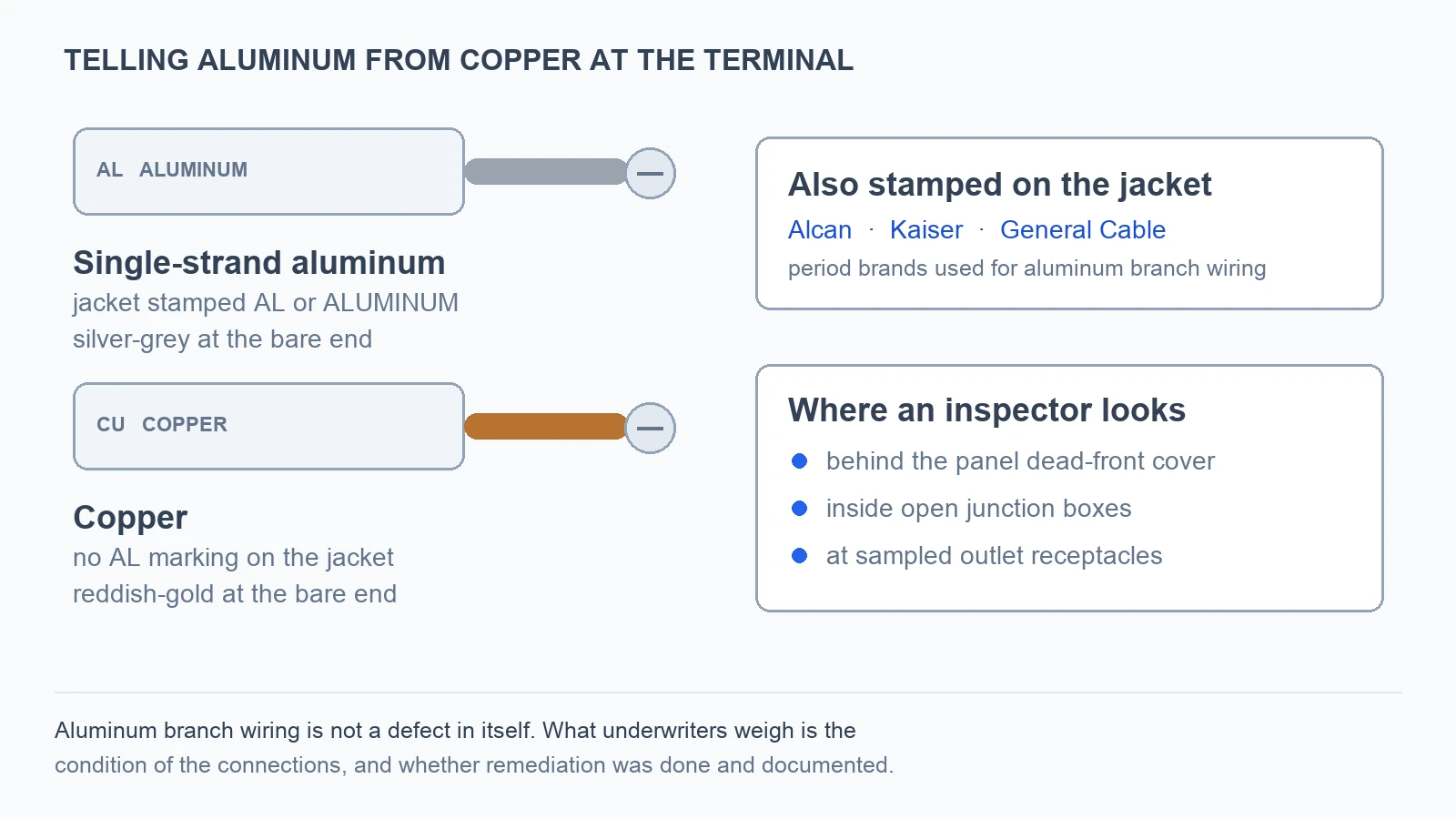
Free to use with credit (CC BY 4.0)
You can use this diagram on your own website, in an inspection report or in training material, including commercially. The one condition is credit to Before Regret as the source. License terms
Or download the image and credit it as “Diagram: Before Regret” with a link to this page.
During the home buying process, aluminum wiring is typically discovered during a general home inspection or through a specialized 4-Point inspection required by insurance companies on older properties.
Home inspectors inspect exposed wiring inside the main circuit breaker panel, at open junction boxes, and at randomly sampled outlet receptacles [ASHI]. Indicators that reveal the presence of single-strand aluminum branch wiring include:
Wire Jacket Markings
The outer plastic or non-metallic sheath (often referred to generically as Romex) protecting the electrical cable is typically stamped with identifying text every few feet. Inspectors look for markings such as "AL," "ALUMINUM," "ALUM," or specific manufacturing brand names associated with aluminum production in the late 1960s and early 1970s, such as Alcan, Kaiser, or General Cable.
Conductor Appearance at Terminals
When an inspector removes the front dead-front cover of the circuit breaker panel or pulls back an outlet cover, the bare metallic end of the wire reveals its composition. Copper wire displays its characteristic reddish-gold tone, whereas aluminum exhibits a distinct silver-grey appearance.
Specialized Inspection Questionnaires
In states with constrained property insurance markets or frequent severe weather events, insurers require a formal 4-Point inspection report focusing on four major systems: roofing, plumbing, HVAC, and electrical. Of those four, roofing is the one a carrier may judge without entering the property at all, using aerial imagery of the roof rather than an inspector. Roofing carries its own underwriting rules, and the hardest case is not age but shape — getting home insurance with a flat roof runs into age limits and water exclusions that a pitched roof never meets. The electrical portion explicitly asks the inspector to identify the branch circuit wiring material. Selecting single-strand aluminum triggers an immediate underwriting review.
Remediation Options Recognized by Insurance Carriers
If an inspection reveals single-strand aluminum branch circuit wiring, obtaining home insurance coverage depends on demonstrating that the system has been properly remediated. Insurers generally accept three main correction methods, provided the work is completed by a licensed electrical contractor and verified with permits or documentation.
Complete Rewiring with Copper
Replacing all single-strand aluminum branch wiring with modern copper conductors is the ultimate permanent solution. While complete rewiring eliminates all future insurance hurdles and restores full home safety confidence, it involves opening drywall, pulling new non-metallic cable through framing, patching plaster or drywall, and replacing all devices. It is by far the most labor-intensive and costly remediation path.
COPALUM Crimp Connector System
The COPALUM connector, developed by AMP Incorporated (now TE Connectivity), is considered a permanent, highly reliable repair method recognized by safety organizations [CPSC]. The process involves attaching a short piece of copper wire (a "pigtail") to the existing aluminum branch wire using a specialized metallic sleeve.
A high-pressure pneumatic crimping tool exerts thousands of pounds of force per square inch, cold-welding the aluminum wire, copper wire, and connector sleeve into a solid metallic mass. This pressure bonding seals out atmospheric oxygen and eliminates galvanic corrosion. The newly attached copper pigtail is then safely connected to standard outlet receptacles and switches.
Because the COPALUM tool requires specialized manufacturer training and certification, only certified electrical contractors can perform this repair.
AlumiConn Lug Connectors
For many homeowners, the AlumiConn connector represents a widely accessible and recognized alternative to COPALUM crimping. AlumiConn connectors are small, insulated aluminum blocks containing separate ports with individual set screws.
An electrician coats the stripped end of the aluminum branch wire with anti-oxidant joint compound, inserts it into one port, and tightens the set screw to a precise manufacturer-specified torque setting. A copper pigtail wire is secured in a separate port and connected to the switch or receptacle. Because the aluminum wire and copper wire never contact each other directly, galvanic corrosion is prevented, and separate set screws isolate mechanical stress.
Most national property insurance carriers accept documented AlumiConn remediation, provided a licensed electrician confirms in writing that every connection point—including outlets, switches, light fixtures, junction boxes, and panel breakers—was converted using proper torque parameters.
Methods Insurers Generally Reject
Home buyers and seller-paid handy-workers frequently attempt quick fixes that do not satisfy property insurance underwriting guidelines. Relying on unapproved methods can result in instant insurance policy cancellation or rejected claim payouts following a loss event.
Standard Twist-On Wire Nuts
Twisting an aluminum wire and a copper pigtail together using standard wire nuts—even yellow or red nuts rated for basic electrical splices—is unsafe and strictly rejected by insurance underwriters. Standard wire nuts exert uneven pressure, leading to loose connections, oxidation, and localized heating [CPSC].
Twist-On Wire Nuts with Anti-Oxidant Paste
While some manufacturers produced specialized wire nuts filled with anti-oxidant gel intended for aluminum wire connections, safety testing showed that these twist-on splices still experienced elevated failure rates under heavy electrical loads [CPSC]. Many insurers explicitly reject twist-on wire nut pigtails, regardless of gel presence.
Replacing Receptacles with CO/ALR Devices Without Splice Fixes
CO/ALR (Copper-Aluminum Revised) switches and outlets are specially designed with terminal screws made from materials compatible with aluminum wire. While installing CO/ALR devices is allowed under building codes as a direct replacement, it only addresses terminal connections at individual switches and receptacles.
It does not address wire-to-wire connections inside junction boxes, ceiling light fixtures, or main panel breakers. Finding a wide design selection of modern decor-style CO/ALR switches and outlets can be difficult. Many insurance underwriters insist on complete pigtailing or rewiring rather than simple CO/ALR device replacement.
Will a Policy Cover Aluminum Wiring Damage?
Getting a policy and having a claim paid are separate questions, and they have different answers.
Fire is a covered peril on a standard homeowners form. The Texas Department of Insurance, describing what most policies in that state cover, lists "fire and lightning" among the damages they pay for and "wear and tear" among the damages they do not. Those two lines decide most aluminum-wiring claims. If a connection overheats and ignites, the fire damage is what the policy responds to. Replacing aging aluminum branch circuits because they are aging is maintenance, and maintenance is what the exclusion names.
The disputes sit between those poles, and they turn on whether the failure was sudden or gradual. One connection that overheated and ignited reads as sudden. Insulation that crumbled over four decades reads as deterioration. Which of those two descriptions the adjuster accepts is usually what a denial rests on.
A third way a claim fails has nothing to do with the wiring. If the application asked about the home's wiring and the answer was wrong, a carrier can seek to rescind the policy for misrepresentation. That problem is created at the application, not at the fire, and it is a reason to know what is behind the walls before anyone fills in the form.
Policy forms are not identical across states or carriers. Read the declarations page for the form name and the exclusions section for the wear-and-tear language, rather than relying on a general description of either.
How Aluminum Wiring Impacts Mortgage Approval
Mortgages cannot close without a active binder for property insurance coverage. If a buyer discovers aluminum wiring during the home inspection contingency period, the following loan processing delays often occur:
- The insurance broker submits the property application to multiple standard-market insurance carriers.
- Underwriters review the 4-Point inspection or disclosure document and flag the single-strand aluminum branch wiring.
- The carrier issues an immediate coverage denial or conditional binder requiring full electrical remediation prior to closing.
- The lender halts loan underwriting because property insurance coverage cannot be verified.
If the seller refuses to repair the wiring or credit the buyer for remediation prior to settlement, the buyer may be forced to obtain temporary surplus-lines insurance. Surplus-lines or excess insurance policies often carry significantly higher premium costs, higher deductibles, and lower coverage limits than standard homeowners policies.
Alternatively, some escrow holdback arrangements permit closing if funds equal to 150 percent of a licensed electrician's repair estimate are placed into an escrow account to complete remediation immediately after closing. However, escrow holdbacks require specific approval from the mortgage lender's underwriting department.
Recommended Actionable Steps for Prospective Buyers
If you are considering purchasing a home built between 1965 and 1976, take these concrete steps before waiving your inspection contingencies:
1. Schedule an Inspection with an ASHI-Certified Inspector Ensure your home inspector opens the main electrical panel dead-front and checks accessible junction boxes to confirm whether single-strand aluminum branch wiring feeds the home's standard circuits [ASHI].
2. Hire a Licensed Electrical Contractor for a Detailed Evaluation If aluminum branch wiring is present, hire a licensed electrician experienced specifically in aluminum circuit remediation. Ask them to provide a written line-item bid detailing whether they will use COPALUM crimping, AlumiConn lug connections, or full circuit replacement.
3. Submit the Electrical Report to an Independent Insurance Agent Work with an independent insurance agent who represents multiple national and regional underwriting carriers. Provide the electrician's repair plan and scope of work upfront to verify which specific carriers will bind coverage upon completion of the repairs.
4. Incorporate Repair Terms into the Purchase Contract Use your repair estimate and insurance feedback during purchase price negotiations. Request that the seller complete approved repairs using a licensed electrician prior to closing, or request a financial concession at settlement to fund post-closing remediation.