Roughly one in five American homes was built before 1950, and many of them still carry some of the electrical system they were born with. Knob-and-tube wiring is the most common survivor. It is also the single most likely reason a home insurance application on an older house gets declined.
Knob-and-tube was the standard method of wiring American homes from the 1880s until it was gradually displaced by sheathed cable through the 1940s and 1950s. Understanding what it is, how to spot it, and what it actually costs to deal with is the difference between walking into an older home informed and finding out during underwriting.
What Knob-and-Tube Wiring Is
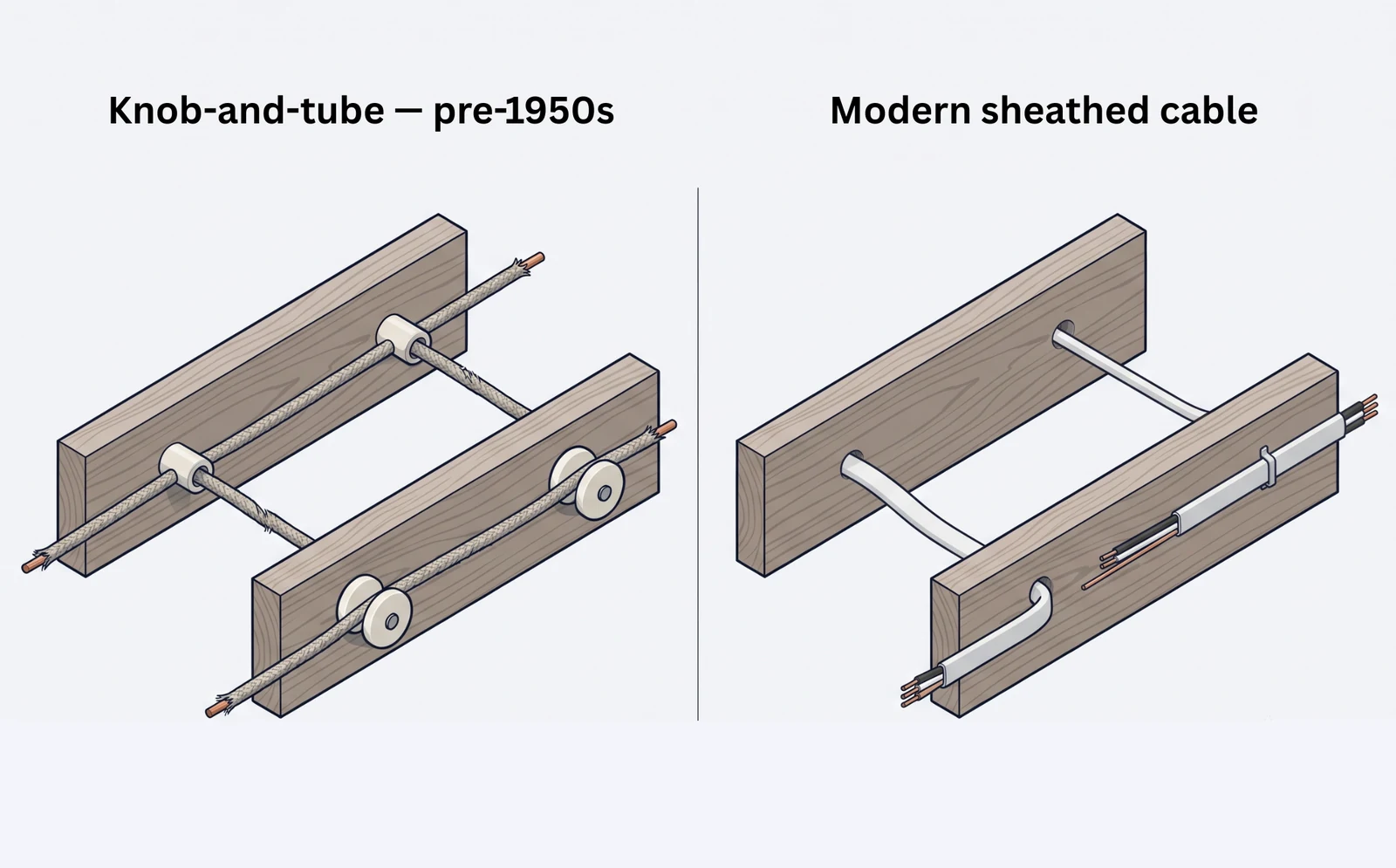
Knob-and-tube gets its name from the two porcelain components that make the system work. Ceramic knobs hold the conductors away from wooden framing, and ceramic tubes line the holes where a conductor passes through a joist or stud so the wire never touches wood.
The defining characteristic is that the two conductors run as separate wires. In a knob-and-tube circuit the hot and neutral travel along different paths, spaced apart, often several inches from each other. Modern cable bundles them together inside one jacket.
Free to use with credit (CC BY 4.0)
You can use this diagram on your own website, in an inspection report or in training material, including commercially. The one condition is credit to Before Regret as the source. License terms
Or download the image and credit it as “Diagram: Before Regret” with a link to this page.
There is a second difference visible in the diagram that matters more than the first: knob-and-tube has no ground wire. It is a two-conductor system. Modern cable carries a third conductor, a bare copper ground, which gives fault current a safe path back to the panel. Every consequence discussed below traces back to one of these two facts.
How to Identify Knob-and-Tube in Your Home
Knob-and-tube is concealed inside finished walls, so most of it is invisible. The places it can usually be seen are unfinished ones: the attic, the basement, and crawl spaces.
Look for these signs:
- White or off-white ceramic knobs attached to joists and studs, with wire wrapped around them
- Ceramic tubes set into drilled holes where wiring passes through framing
- Individual wires running separately rather than a single cable containing multiple conductors
- Cloth or rubber insulation on the conductors instead of modern plastic sheathing
- No ground wire anywhere in the run
- Two-prong outlets throughout the house, which indicate ungrounded circuits
A critical distinction: seeing knob-and-tube does not mean it is energized. Many homes have been partially rewired, leaving abandoned knob-and-tube in place because removing it means opening walls. Abandoned wiring is harmless. Active wiring is the thing insurers care about. Telling them apart requires a licensed electrician with a meter, not a visual guess.
Fuse Boxes, Outlets, and Switches
Knob-and-tube usually arrives with a set of companions from the same era.
Fuse boxes. Homes on original knob-and-tube frequently still have a fuse panel rather than a breaker panel, often with 60-amp service. A modern household typically expects 100 to 200 amps. The service capacity, not just the wiring method, is often the real limitation.
Outlets. Because there is no ground conductor, original knob-and-tube circuits feed two-prong outlets. Replacing a two-prong outlet with a three-prong one does not create a ground. It creates the appearance of one, which is more dangerous than the original, because it invites people to plug in equipment that assumes grounding exists.
Switches and junctions. In original knob-and-tube installations, splices were often made by twisting and soldering conductors together and wrapping them, without a junction box. Modern code requires accessible junction boxes for connections.
Is Knob-and-Tube Wiring Dangerous?
Knob-and-tube installed correctly and left undisturbed was a sound system for its era. The hazards in a house today come mostly from what has happened to it in the intervening decades.
Deteriorated insulation. The original rubber and cloth insulation has a finite life. After many decades of heating and cooling cycles it can become brittle and flake away, exposing energized copper inside wall cavities. The U.S. Consumer Product Safety Commission has long identified failures in home electrical distribution systems as a significant contributor to residential fires.
Contact with thermal insulation. This is the most important and most frequently created hazard. Knob-and-tube was designed to shed heat into open air, which is why the knobs hold it away from framing. When a later owner blows insulation into an attic or wall cavity containing active knob-and-tube, that heat can no longer escape. NEC Article 394 prohibits concealed knob-and-tube in insulated spaces for exactly this reason. A great many homes have had insulation added over active knob-and-tube by owners who had no idea it mattered.
Overfusing. When circuits designed for a 1930s electrical load run a modern household, fuses blow. The common homeowner response was to install a higher-rated fuse, which removes the protection the fuse existed to provide and allows the wire to carry more current than it was rated for.
Amateur modifications. Decades of additions tied into original runs, often without junction boxes and without any load calculation, are frequently the worst thing an electrician finds.
Is It Legal? Does It Have to Be Replaced?
New knob-and-tube installation is prohibited under the National Electrical Code.
Existing installations are a different question. Under the NEC, existing electrical installations that do not conform to current code are generally permitted to remain in use unless the authority having jurisdiction determines the nonconformity presents an imminent danger. In other words, there is typically no legal requirement to remove functioning knob-and-tube simply because it exists.
The practical pressure comes from insurance rather than code. Many carriers decline to write a policy on a home with active knob-and-tube, and because mortgage lenders require an active policy before funding, an insurance refusal can stop a purchase even when nothing about the wiring is illegal. That dynamic is covered in detail in Does Knob-and-Tube Wiring Need Replacing Before Closing?.
What Replacement Actually Costs
Rewiring cost varies too widely by region, house, and scope for any single national figure to be meaningful, and the widely circulated ranges come from contractor lead-generation sites rather than from any public dataset. Rather than repeat a number we cannot trace, here is what actually drives the price, so you can read a quote and know whether it is reasonable.
Wall access is the biggest variable. Rewiring during a renovation with walls already open costs dramatically less than rewiring a finished house, where the work includes cutting into plaster or drywall and repairing it afterward.
Plaster versus drywall. Older homes with lath and plaster are more expensive to open and to repair than drywall.
Attic and crawl space access. Good access from above and below lets an electrician pull much of the new wiring without opening finished walls.
House size and circuit count. Cost scales with the number of outlets, switches, and fixtures, not just square footage. Many electricians quote per opening.
Whether the service panel is included. A home on original knob-and-tube often still has 60-amp fuse service. Upgrading to a modern panel involves the utility and adds both time and cost.
Permits and inspection. Electrical work of this scope requires a permit and inspection in essentially every jurisdiction.
Partial versus whole-house. Some homes only need remaining active knob-and-tube circuits replaced, not a full rewire, if earlier owners already did part of the work.
Get at least three itemized quotes from licensed electricians, and make sure each one states clearly whether it includes drywall or plaster repair and whether it includes a panel upgrade. Those two items account for most of the variation between bids.
Replacing Knob-and-Tube with Modern Cable
Replacement means running new sheathed cable, commonly called by the trade name Romex, from the panel to each device, and abandoning or removing the old conductors.
Two things are worth knowing before you plan the work. First, replacement does not usually require gutting the house. An experienced electrician working from an attic and basement can often reach a large share of a home's circuits with limited, patchable openings. Second, the work is normally staged. Rewiring the circuits that are still active on knob-and-tube, then upgrading the panel, is a common sequence that spreads the cost.
This is not do-it-yourself work. It requires a licensed electrician, a permit, and an inspection.
What It Costs to Confirm, and What It Costs to Fix
Identifying knob-and-tube is usually part of a general inspection, but only if you ask for it in writing. A dedicated electrician evaluation runs $150 – $350, and that is the version worth paying for when the wiring is partly concealed.
The repair is the number that changes a purchase decision: $8,000 – $30,000+ for a partial to whole-home rewire.
There is a second cost that is not a repair bill. Knob-and-tube wiring — many insurance carriers will not write a policy while it is still energized. That makes it a financing problem as much as an electrical one, because a mortgage will not close without a binder.
What to Do Next
If you are buying a home built before 1950, or you have found ceramic knobs in your own attic, the sequence that saves the most money is:
- Establish what is active. Have a licensed electrician determine which knob-and-tube circuits are still energized. This single fact drives everything else.
- Check insurability before your contingency period ends. If you are under contract, call insurers early. An insurance refusal discovered late is what turns a manageable repair into a failed closing.
- Get itemized quotes that separate wiring, wall repair, and panel work.
- Verify permits were pulled for any electrical work a seller says was already done. Work done without a permit was never inspected.
If the home has aluminum wiring rather than knob-and-tube, that is a separate issue with its own insurance treatment, covered in Can You Get Home Insurance with Aluminum Wiring?.