Discovering active knob and tube wiring days before closing can immediately derail a purchase, putting earnest money deposits at risk and jeopardizing mortgage approval. If you are not yet sure that is what you are looking at, what knob-and-tube wiring is and how to identify it covers the attic tells and what replacement actually costs. Resolving this issue under tight contract deadlines often leads to rushed negotiations, unbudgeted electrical repairs, or a cancelled sale.
Knob and tube wiring was the standard electrical distribution method installed in North American residential construction from the late 1800s through the 1940s. Understanding how this aging system functions, why underwriters view it as a major risk, and what steps are required prior to closing helps prospective buyers navigate the underwriting process without unpleasant surprises.
How Knob and Tube Wiring Works
Knob and tube systems rely on single insulated conductors run inside wall cavities and floor joists. Porcelain knobs anchor the wiring along wooden structural framing, keeping the conductors securely suspended in open air. Porcelain tubes shield the wire whenever it passes directly through wooden joists or studs.
Unlike modern non-metallic sheath cables that bundle hot, neutral, and ground conductors into a single protective jacket, knob and tube systems keep hot and neutral wires physically separated by several inches. The system relies on open space around the conductors to dissipate excess heat generated by electrical current.
These systems were originally designed to power light electrical demands, such as incandescent bulbs and small household appliances. They do not include an equipment grounding conductor, meaning outlets attached to knob and tube circuits are ungrounded two-prong receptacles.
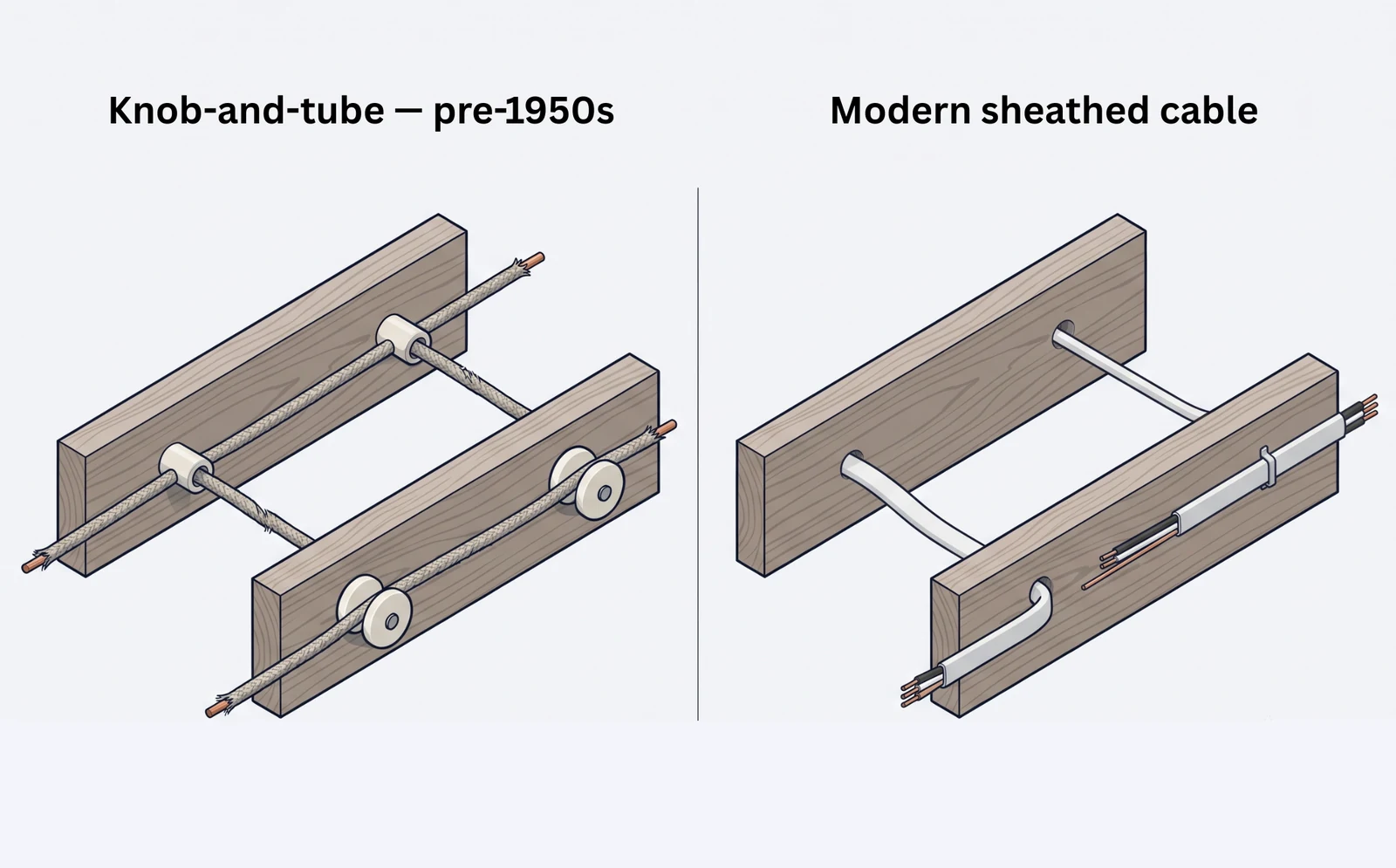
Free to use with credit (CC BY 4.0)
You can use this diagram on your own website, in an inspection report or in training material, including commercially. The one condition is credit to Before Regret as the source. License terms
Or download the image and credit it as “Diagram: Before Regret” with a link to this page.
Why Mortgage Lenders and Insurers Object
No federal or state law mandates the removal of knob and tube wiring simply because a house is changing hands. However, real estate transactions rarely fail due to municipal property building codes alone; they fail because of private underwriting standards enforced by mortgage lenders and home insurance companies [CFPB].
Property insurers view knob and tube wiring as an elevated fire hazard for several clear mechanical reasons:
- Lack of grounding: Without a dedicated grounding wire, modern sensitive electronics and surge protectors cannot divert power surges safely to ground, elevating the risk of electrical arcs and damaged equipment.
- Aging insulation: The original cloth or rubber insulation wrapping the copper conductors dries out, becomes brittle, and flakes off over time, exposing bare copper wire inside walls.
- Thermal buildup: Modern home renovations often add blown-in cellulose or fiberglass insulation into attics and wall cavities. Enclosing knob and tube conductors in thermal insulation prevents heat dissipation, creating a documented ignition hazard [NFPA].
- Unsafe modifications: Decades of DIY additions often lead to improper splicing with modern NM cable outside approved junction boxes, or the installation of oversized fuses to support heavier electrical loads than the original wire gauge was built to carry.
Because mortgage lenders require evidence of a valid, fully bound home insurance policy before releasing loan funds, an insurer’s refusal to cover a property effectively halts the mortgage approval process.
How Home Inspectors Detect Knob and Tube
A standard visual home inspection routinely identifies active knob and tube wiring by evaluating exposed framing in basements, crawlspaces, and unfinished attics [ASHI]. Inspectors look for characteristic porcelain hardware mounted along floor joists or rafters.
Determining whether observed knob and tube wiring is active or abandoned requires electrical testing. It is common in older homes to find leftover knob and tube framework that was disconnected decades ago when a breaker panel was installed, while the functional circuits behind living room or bedroom walls remain connected to the live service.
Inspectors use non-contact voltage testers to check exposed conductors and verify whether three-prong outlets in finished rooms are incorrectly wired to ungrounded knob and tube circuits using fake ground connections, known as open grounds or false grounds.
Options for Addressing Knob and Tube Before Closing
When a home inspection report confirms active knob and tube wiring, buyers and sellers generally choose between three pathways to reach the closing table:
1. Full Electrical Rewire
Replacing the active knob and tube system entirely with modern grounded circuits provides the cleanest resolution for both insurance carriers and lenders. This process involves pulling modern cable through existing walls, installing modern junction boxes, updating three-prong outlets, and bringing the home up to current electrical codes. Partial jobs raise their own question, because the two systems meet somewhere — whether Romex can be spliced to knob and tube is the detail an inspector looks for at that junction.
Because full rewiring requires cutting into finished plaster or drywall, the work must be performed by a licensed electrical contractor and usually requires local building permits and inspections.
2. Specialized or High-Risk Insurance Coverage
Some regional surplus-lines insurers or state-backed insurance programs will issue temporary coverage on a home with knob and tube wiring. However, these policies often carry significantly higher premiums, limited coverage terms, or mandatory repair riders requiring complete system replacement within 30 to 90 days following closing.
If a buyer utilizes high-risk insurance to satisfy lender requirements at closing, they must budget for complete rewiring shortly after moving in to qualify for standard insurance rates later.
3. Circuit Remediation and GFCI Upgrades
In limited cases, an insurance underwriter may agree to cover a property if a licensed electrician certifies that the knob and tube circuits are structurally sound, free of thermal insulation contact, and protected by Ground Fault Circuit Interrupter (GFCI) breakers or outlets.
GFCI protection provides personal shock protection on ungrounded circuits, though it does not provide an equipment ground for sensitive electronics. Approval for this compromise depends entirely on the specific guidelines of the selected home insurance carrier.
Navigating Purchase Contract Negotiations
If active knob and tube wiring is identified during the contingency period, buyers must act quickly to evaluate their financing and insurance options before closing dates approach.
- Requesting seller repair prior to closing: The buyer requests that the seller hire a licensed electrician to rewire the affected circuits and obtain municipal inspection sign-offs before loan funding.
- Negotiating a closing credit or price reduction: If the seller is unwilling to perform repairs prior to closing, the buyer may negotiate a credit toward closing costs or a lower purchase price to offset the anticipated rewiring expense post-closing, provided an insurer will bind temporary coverage.
- Utilizing repair escrows: Some lenders permit a portion of seller proceeds to be held in an escrow account managed by the title company, releasing funds directly to a licensed electrical contractor once rewiring is completed post-closing.
Every option requires clear documentation signed by both parties and approved by the buyer's mortgage loan officer and insurance agent well in advance of the settlement date.
The Numbers Behind the Decision
Whether it has to go before closing usually comes down to two figures rather than to code.
A rewire runs $8,000 – $30,000+. Confirming what you are dealing with is cheaper by orders of magnitude: usually included in a general inspection if you ask for it explicitly, or $150 – $350 for a dedicated electrician evaluation.
The reason it so often has to happen before closing rather than after is the insurance one. Knob-and-tube wiring — many insurance carriers will not write a policy while it is still energized. Ask an independent agent for a real quote on the address before your contingency expires, not after.
The Buyer's Immediate Action Step
If you are under contract on a home built before 1950, do not wait until the final home inspection report to address electrical risk.
Contact a local independent insurance agent today and request a preliminary binding review for the property address. Ask directly what their preferred carriers require regarding ungrounded knob and tube circuits, thermal insulation restrictions, and post-closing repair timelines. Knowing these carrier requirements upfront gives you the leverage needed to negotiate necessary electrical repairs or repair credits before your inspection contingency period expires.