Collier County doesn't keep a house's permit history in one place. Its permit history and search page splits the record by date: permits from 2011 on are in the CityView public portal, permits from 1989 to 2011 are in an older system called CDPlus, and anything before 1989 is listed on the Property Appraiser's site. Search only the current portal and you see a house's recent work, not the permit that built it.
So start by working out which of the three a house's records are likely to be in, then search every one that applies.
Which system holds the house's permits
The year the house was built points to where its construction permit lives. We matched Census figures for Collier to the county's three date ranges:
| When the house was built | Where the construction permit is | Share of Collier homes |
|---|---|---|
| Before 1980 | The Property Appraiser's permit list | 16.6% |
| 1980s | The Property Appraiser before 1989, CDPlus from 1989 | 19% |
| 1990 to 2009 | CDPlus | 46.3% |
| 2010 or later | CityView, or CDPlus if the permit came before the switch | 18.1% |
Put together, 81.9% of Collier's homes were built before 2010, so for about four in five houses the permit that built them isn't in CityView at all. Later work can sit in any of the three. A house from the 1980s might have its original permit on the Property Appraiser's site, a roof from the late 1990s in CDPlus and a recent air-conditioner change-out in CityView.
Two caveats on the table. Census counts year built, not the year a permit was issued, so a house finished early in one year can carry a permit from the year before. And the 1980s row straddles the 1989 switch, so for a house from that decade, check both.
Make sure the county issued the permits
Naples and Marco Island run their own building departments. Naples has its own public portal for permit search, and Marco Island uses a Civic Access permitting portal. For a house inside either city, a county search is the wrong place to look, and an empty county result tells you nothing. If you aren't sure where the city limits fall, ask the city's building department before reading anything into a blank search.
Everglades City works differently. The county runs a permit office there at 102 Copeland Avenue, open Monday, Wednesday and Friday, and publishes an interlocal agreement with the city on its permitting pages. We didn't read the agreement itself, so ask the county which records it holds for an Everglades City address.
Searching CDPlus: what we found
The External CD-Plus Search opens without an account. Choose Building Review and Permitting, and you get five boxes: Permit Number, Owner Name, Owner Address, Permit Address Number and Permit Street Name.
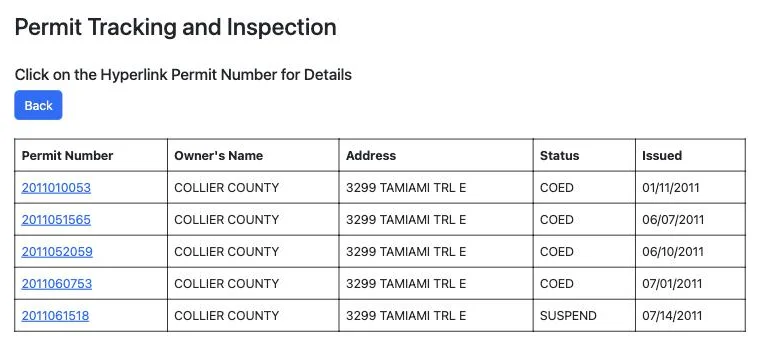
We tested it on 17 November 2026 on the county's own Government Center, 3299 and 3301 Tamiami Trail East. Three things would trip up a buyer:
- Type the street name alone. 3299 with TAMIAMI returned 5 permits. The same number with TAMIAMI TRL, TAMIAMI TRAIL or E TAMIAMI returned nothing, even though every record stores the address as 3299 TAMIAMI TRL E. An empty result after typing the full street name isn't an empty history.
- The list stops at 200. The form says so in red: "Only the top 200 records will be returned." At 3301 we got exactly 200 rows, issued from 1989 through 2004, and nothing later, though CDPlus runs to 2011. A single house rarely has that many permits; a condo building sharing one street address could. Typing part of a permit number didn't narrow it: 2008 with the same address returned nothing.
- 2011 sits in both systems. All 5 permits at 3299 were issued between January and July 2011, the year CityView's range starts. For anything from 2011, search both.
The permit number also hints at its era. At 3301, permits from 1989 to 1994 had nine digits starting with the year (900010108 was issued in 1990). In 1997 and 1998 they had eight (97040151). From October 1998 they had ten, starting with the year and month (1998100261). We saw that at one address and haven't confirmed it holds countywide.
Reading a status: two that sound backwards
The county's web page gives a short rule: "Permit(s) in a status: COED, Finaled, Abandoned, Denied, or Cancelled are CLOSED and require no further action." Its full definitions are in Bulletin 14, last amended in 2023, and for CDPlus permits the bulletin is the one to read. Two of its CDPlus statuses mean close to the opposite of what they sound like:
- SUSPEND is closed. It isn't on the web page's short list, but the bulletin says a suspended CDPlus permit "has been cancelled with proper docs provided and no further action needed. This permit is no longer considered an open issue."
- VOID is open. It sounds finished, but the bulletin says it "requires action to be taken": the application has to be made again or cancelled by request.
Cancelled and CANCEL differ, too. Cancelled is closed. CANCEL, a CDPlus-only status, "requires additional research to be performed and may require the permit to be extended, reapplied for or set to suspend." So does EXPIRED.
Among the 200 permits at 3301, CDPlus showed COED on 148, VOID on 31 and SUSPEND on 21. COED is the CDPlus word for finished: completed, inspected, conditions resolved, certificate issued.
Here's why the sound of a status misleads. Permit 2011061518 was a fire alarm job in Building F at 3299:
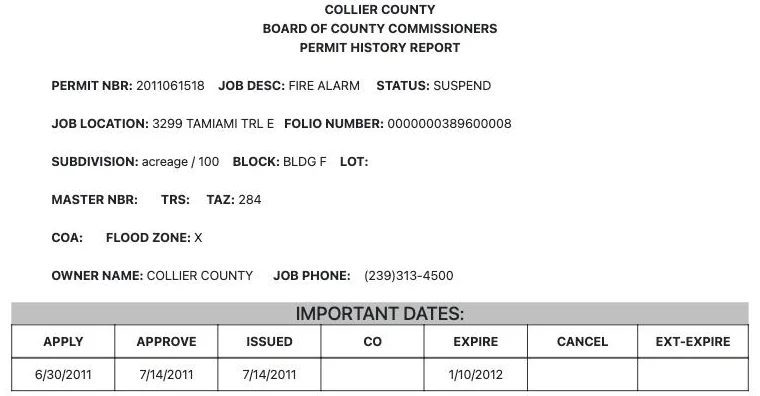
It was issued on 7/14/2011 and expired on 1/10/2012. The CO column is blank, and its five inspection codes, 603, 604, 618, 650 and 901, have no request date, result or inspector against any of them. Read cold, that's a permit issued and never inspected. Under Bulletin 14, SUSPEND means it was cancelled with the paperwork done, and the county no longer treats it as open.
The county adds one more warning about CDPlus itself: "Large portions of permit data are not current." So whatever the status, confirm it where the county says to, in CityView, where CDPlus permits carry a CDP prefix in front of the number. For a house you're buying, write down every permit showing VOID, CANCEL or EXPIRED, look each one up in CityView under Status and Fees, and if it's still open there, ask the seller to close it before you close. If two county sources disagree about a status, Building Permit Resolution Services can say which applies.
Before 1989: the Property Appraiser's list
For older houses, the county sends you to the Collier County Property Appraiser. Its instructions: open Property Search, search by owner, site address or parcel, then open the Detail tab. Permit numbers there read as the year applied, then the number, such as 88-02967. "If there is no date in the CO Date column the permit is open." The permit documents themselves come through a public records request, and the property cards are on the Cards tab.
The county adds a warning of its own: read the Property Appraiser's full disclaimer about the permits it lists. The search also opens with a Terms of Use and Cookies agreement. We didn't accept it, so we haven't seen a Detail tab ourselves; everything in this section is the county's description.
A blank CO date on a permit from decades ago is common enough to be worth asking about early. The county's resolution team can tell you whether it still needs anything.
Since July 2026, some work has no permit on purpose
A 2026 state law, HB 803, added an exemption to Florida Statutes § 553.79(1)(g). The county's notice puts it as "certain qualifying work valued under $7500.00". The statute says a local government "shall exempt an owner of a single-family dwelling or the owner’s contractor from the requirement to obtain a building permit to perform any work valued at less than $7,500 on the owner’s property."
The exceptions are wide. The exemption doesn't cover electrical, plumbing, structural, mechanical or gas work, and it doesn't apply at all to a property partly or entirely in a flood hazard area. A project can't be split into smaller ones to get under the limit.
For a buyer, that changes how to read a short permit list. Small non-structural work done after July 1, 2026 can be legitimately unpermitted. It still leaves paper: to qualify, the owner or contractor "must submit a written request for exemption to the local enforcement agency with a copy of the contract or other documentation demonstrating the nature and the value of the work to be performed." Ask the seller for that request. We couldn't confirm where Collier files these or whether they show in CityView. And the statute says the local government "has no legal duty" for exempted work, so nobody from the county looked at it. Your inspector is the check.
The same law gave single-family permits a clock. One now expires 1 year after it's issued or when the next edition of the Florida Building Code takes effect, whichever is later, though the county can extend it. A recent job with no final can tip into expired quickly.
A clean lien search isn't a clean permit history
Collier's Code Enforcement sells a lien search for $25 per address, requested through the county portal with an account. It's worth doing: the county tells buyers that "All existing code violations, fines, and liens go with the property and become the responsibility of the new owner when sold." It caps a code enforcement lien at 20 years.
But read what it leaves out. The county says the results "will not report issues beyond the Code Enforcement Department’s jurisdiction, such as open permits and utility bills". A lien search and a permit search answer different questions, so do both.
When something is still open
The county's steps are to request the permit file from its Records Room, get the property card, and contact Building Permit Resolution Services. Florida law then makes closing easier than you might expect. Under § 553.79(16), any property owner can close a permit, whether or not they're the one named on it, and can hire a different licensed contractor to do it. Our guide to open permits before closing covers what a buyer can ask for.
One limit runs the other way. A missing record in any of these systems doesn't prove the work was done without a permit. CDPlus caps its results and warns its data isn't current, and the pre-1989 records are a list of numbers, not files. Before you conclude something was never permitted, ask the Records Room.
For other counties, our permit lookup guide lists where each one keeps its records. Across the state, the Pinellas County guide covers a portal with its own quirks.
What Collier County Is Permitting Right Now
Collier's overall count is up 9.3% at 2,717 units so far this year; single-family permits are up 0.7%, 1,632 homes a year ago against 1,644 now, and multifamily is up 25.8% to 1,073 units. If you're weighing an older house against new construction, watch the single-family line rather than the total. The Census file also counts permits from Naples and Marco Island, which keep their own records.
Source: US Census Bureau Building Permits Survey, county file, year to date through September 2026 against the same months of 2025. 95.5% of these units were reported directly by permit offices; the rest are Census estimates for offices that did not report.
How we checked this
On 17 November 2026:
- We searched the External CD-Plus Search at 3299 and 3301 Tamiami Trail East, the county Government Center. We tried four spellings of the street, a partial permit number and the cap of 200 rows, and opened permit 2011061518. The screenshots are from those searches; we cropped out the contractor and a contact person.
- We read the county's pages on building permits, permitting resources, permit history and search, Everglades City, buying a home and lien searches, and its Bulletin 14 on permit statuses (PDF).
- We read the Naples and Marco Island building pages and Naples's page on the new exemptions.
- We read § 553.79 in The 2026 Florida Statutes, and HB 803's bill history and Senate summary.
- The table is our calculation from the Census American Community Survey 5-year estimates for 2020-2024, table B25034.
What we couldn't check:
- CityView, the Naples portal and the Marco Island portal all refused connections from our location, so we haven't tested the current portals;
- the Everglades City agreement, a scanned PDF we couldn't read as text;
- a Property Appraiser Detail tab, since we didn't accept its terms;
- whether the permit-number pattern holds beyond one address.