Pinellas County's permit records are in the Pinellas County Access Portal, and you can search them by address without an account. Two things make it harder than it looks. The county only holds permits for part of the county. And when we searched one address on 16 November 2026, the portal returned it 8 times, with its older permits filed under different entries from its recent ones. If you're buying a house here, both of those decide whether you see its whole history or only the last few years.
Is the house in the county's area?
The county's building department issues permits for:
- unincorporated Pinellas County;
- Belleair Beach, Belleair Shore and Indian Rocks Beach;
- Kenneth City, Safety Harbor and Oldsmar.
Everywhere else, the city runs its own building department and keeps its own records. That covers St. Petersburg, Clearwater, Largo, Pinellas Park, Dunedin, Seminole and Tarpon Springs, plus most of the beach towns. If the house is in one of those, this portal is the wrong place, and searching it will look like "no permits".
The mailing address won't tell you which one you're in. When we searched Ulmerton Road, county records came back with Largo and Clearwater addresses. The condo milestone records for Tierra Verde, which is unincorporated, list their buildings as St Petersburg FL 33715. The county's advice is to check the address on its My Neighborhood Services tool or on pcpao.gov, the Property Appraiser's site.
One town changed hands recently. Belleair Bluffs moved its permitting and inspections from the county to a private firm, SAFEbuilt, on August 15, 2025. Permits that were already open stay with the county through final inspection. So a Belleair Bluffs house can have records in both places.
One address, eight entries
From the portal's home page, go to Build, then Search Permits, then choose Search by Address in the search-type menu. The street number has two boxes, a From and a To. Put the same number in both, add the street name and search. The county's own instructions say what comes next: select the parcel that matches your project site.
We tested it on 12520 Ulmerton Road in Largo, the Florida Botanical Gardens, which the county owns. Instead of one parcel, the portal listed the same address 8 times:
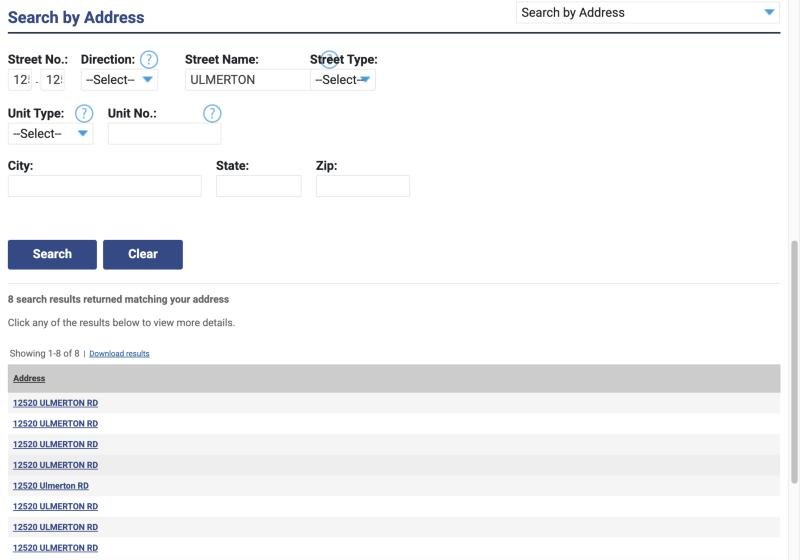
They aren't duplicates. We opened every one:
- The first entry listed 22 records. The oldest was from 12/28/2020.
- The next three listed 18, 19 and 15 records, starting with the same recent permits.
- One listed no records at all.
- Two listed only 5 permits, from 2007 to 2019, and none of the five appeared under the first entry. Their numbers all start with PER-H, such as PER-H-CB07-12350.
So a buyer who clicks the first match sees nothing older than late 2020. For a house built or renovated before then, open every entry. Write down any permit number starting PER-H; those were the ones missing from the first list.
The General Search tab has a different catch. Its dates default to the last two years, and the county's instructions say to change the start date for older records. The Accela Citizen Access guide explains that setting, which other Accela portals share. A partial permit number also works there, with % as a wildcard before and after, such as %2906%.
What a record shows without logging in
Click a permit number to open it. The Record Info menu has Record Details, Processing Status and Attachments, and the Inspections tab opens without an account too. The county's own instructions for checking a result use the same route. You can also text Results to 844-746-1717 with the permit number.
The 2007 deck permit at the Gardens shows how an inspection history reads:
- 07/21/2008: the deck inspection got a red tag.
- 07/24/2008: the deck inspection was approved three days later.
- September 2008: the final was approved.
Under the result labels, the record counted Approved, Red tag, "Red tag to yellow tag" and Cancelled. The county pages we read don't define red and yellow tags, so we won't guess at them. What matters to a buyer is the order. A red tag followed by an approval of the same inspection reads as something fixed and passed on a later visit. A permit whose last entry is a failed or cancelled inspection, with no approved final after it, is worth asking the seller about. In the county's list of inspection types, the building final is number 1099 and a partial final is 1097.
Statuses differ by record type. The two oldest records under the first entry read CofO Issued and CofC Issued, which read as a certificate of occupancy and a certificate of completion. The old PER-H permits read Finaled.
After Helene and Milton: the storm damage records
For a house in a flood zone, the county's storm pages matter as much as the permit list. The county is direct about it: "Permits resulting from Hurricanes Helene and Milton are not exempt from Substantial Damage/Substantial Improvement rules."
The rule works like this. If repairing a damaged home costs 49% or more of its value without the land, the county treats it as Substantially Damaged. It then can't be repaired without being brought up to current floodplain code, which can mean elevating or replacing it. New or substantially improved buildings must sit at least one foot above the base flood elevation.
A buyer can check three things before closing:
- The county's damage map. The Initial Substantial Damage Assessment map lets you search an address and click its red or green dot. It covers unincorporated Pinellas only, since each city runs its own assessments. The county's letter lookup shows only determinations it has mailed, so a missing letter isn't a clean bill.
- The repair budget. On pcpao.gov, search the address and click FEMA/WLM Letter in the Quick Pick Tool Box. It shows what can be spent on repairs: up to 49% of the structure's value. An owner who thinks that value is too low can ask the Property Appraiser for a free pre-storm reconsideration, then pay for a private appraisal, and use either to apply for a reassessment. The portal has a record type for it, Storm Damage Reassessment.
- The repair permits. If the house was repaired after the storms, the permits should be in the portal. The county warns owners that unpermitted repairs might have to be undone at their own expense, and after closing the owner is you.
Two more flood records are easy to miss. For a new or substantially improved building in the special flood hazard area, the county has required since January 1, 2019 that the owner record a Nonconversion Acknowledgment For Certain Structures in the Floodplain on the deed with the Clerk of the Courts. If the house was elevated or rebuilt, ask to see it and read what it commits the owner to. And if the house is in a Coastal Barrier Resources System unit, the federal rule is stark: "If an existing insured structure is substantially improved or damaged, the federal flood insurance policy will not be renewed."
Your agent can help here. Through a program with the Suncoast Tampa Association of Realtors, agents across the county, cities included, fill in a flood disclosure brochure with the property's flood risk, evacuation level and insurance requirement. Ask for it. The general steps for any address are in our flood zone lookup guide.
Buying a condo: milestone records are public here
Florida requires condo and co-op buildings three stories or taller to have a structural milestone inspection at 30 years, then every 10 years. In the county's area those records sit in the same portal. In General Search, set Record Type to Milestone Inspection Record. Numbers start with BMS-, and the statuses we saw were Good Standing and Phase I Required. A phase two inspection follows only if phase one finds substantial structural deterioration.
One local detail matters on the coast: a garage or parking area beneath the living space counts as a story. The county administers the program under Ordinance No. 24-18.
The record tells you where a building stands; the report tells you why. Under Florida Statutes § 553.899, the architect or engineer sends a sealed copy of the report, with a separate summary of its material findings and recommendations, to the association and to the local building official. Ask the association for that summary before you sign. Read it for what it is, too: the statute says the inspection's purpose "is not to determine if the condition of an existing building is in compliance with the Florida Building Code or the firesafety code." The Broward County permit guide covers more of the state law and what to ask a condo association.
Liens and permits nobody closed
A permit search won't show code enforcement liens. Those are a separate Lien/Violation Search on the same portal, and that one needs an account. The county's wording on who pays is plain: "Either the property owner or a buyer needs to pay the debt before the lien is removed." The county's code enforcement covers the unincorporated area, while unlicensed-contracting complaints are investigated countywide.
An open permit can also have no contractor behind it any more. The county has a form a contractor can file to be released from a permit when a homeowner refuses access for required inspections. If a permit shows no final, ask the seller who is responsible for closing it. Our guide to open permits before closing covers what Florida law lets a buyer do about one.
For Tampa and the rest of Hillsborough County across the bay, the records are in different systems; see the Hillsborough County permit guide.
What Pinellas County Is Permitting Right Now
Pinellas County's headline permit figure points the opposite way from its house market. Single-family permits are up 11.6%, from 958 to 1,069 homes, while multifamily is down 28.5%, from 1,384 to 990 units, which is enough to pull the county total down 12.1%, 2,342 to 2,059. These counts cover every permit office in the county, St. Petersburg and Clearwater included, so they reach well beyond the area the county's own Access Portal serves.
Source: US Census Bureau Building Permits Survey, county file, year to date through September 2026 against the same months of 2025. 97.9% of these units were reported directly by permit offices; the rest are Census estimates for offices that did not report.
How we checked this
On 16 November 2026 we used the Pinellas County Access Portal in a browser without logging in:
- We searched 12520 Ulmerton Road by address, opened all 8 entries and counted their records.
- We opened the 2007 deck permit and its Inspections tab.
- We ran a General Search for Milestone Inspection Records.
The screenshot shows that search on county-owned property. We left out names that appear on other records.
From pinellas.gov we read the building departments list, the permitting guide, the inspections page, the storm damage and floodplain construction pages, the flood disclosure program, the condo milestone page, and the code enforcement and lien search pages. We also read the county's Nonconversion Acknowledgment policy (PDF) and opened the damage assessment map.
What we couldn't confirm:
- what the red and yellow tag labels mean;
- why older permits sit under separate entries, or whether every address is split the same way;
- what the Nonconversion Acknowledgment form itself says;
- any city's portal, since we opened none of them.