Failing to address electrical defects identified during a home inspection can expose future homeowners to hidden shock hazards and fire risks that remain silent until someone touches an appliance or changes a lightbulb. When a home inspector flags "reverse polarity" at one or more outlets, buyers are often left wondering whether it represents a minor terminal slip or a dangerous systemic issue.
Understanding Polarity in Standard Electrical Circuits
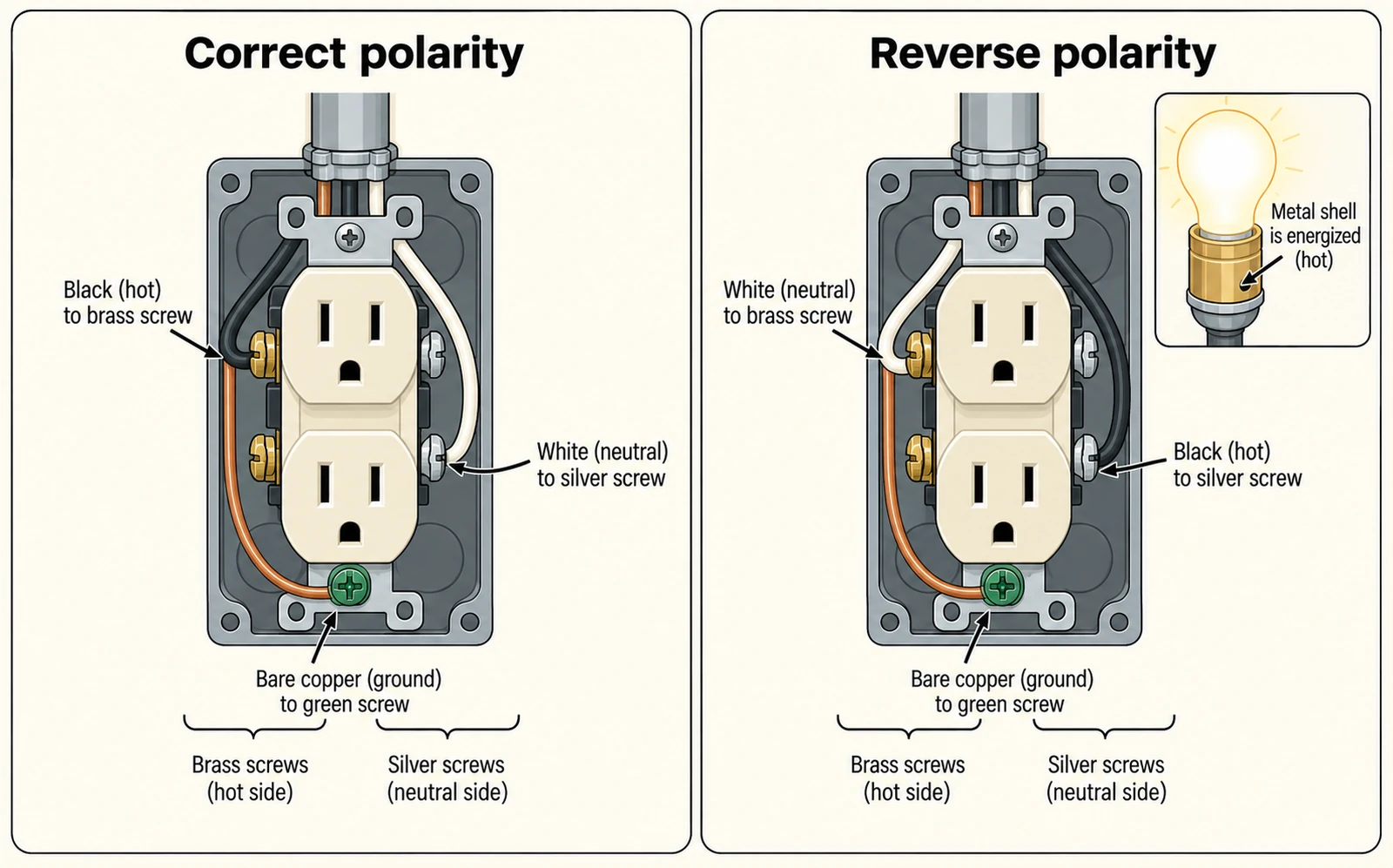
Free to use with credit (CC BY 4.0)
You can use this diagram on your own website, in an inspection report or in training material, including commercially. The one condition is credit to Before Regret as the source. License terms
Or download the image and credit it as “Diagram: Before Regret” with a link to this page.
To understand reverse polarity, it helps to review how standard alternating current (AC) electrical circuits operate in residential properties. In standard 120-volt electrical systems across the United States, electricity travels from the main service panel to individual wall receptacles through branch circuit wiring. A standard modern outlet relies on three distinct conductors: the hot wire, the neutral wire, and the ground wire.
The hot wire—typically covered in black or red insulation—delivers current from the breaker panel to the outlet. The neutral wire—typically wrapped in white insulation—completes the electrical loop back to the main service panel, returning the current to complete the circuit. The ground wire—either bare copper or covered in green insulation—serves purely as a safety pathway designed to divert fault currents directly to the earth and trip the circuit breaker if a live wire contacts a conductive surface.
Under standard National Electrical Code guidelines, these wires must connect to specific terminals on the outlet fixture [NFPA]. The hot wire connects to the brass terminal screw, which leads to the smaller vertical slot on the face of the outlet. The neutral wire connects to the silver terminal screw, which powers the wider vertical slot. When an installer accidentally attaches the hot wire to the silver terminal and the neutral wire to the brass terminal, the outlet enters a condition known as reverse polarity, or a hot/neutral reverse.
Why Reverse Polarity Creates Shock and Fire Hazards
At first glance, reverse polarity might appear harmless because appliances plugged into a reversed outlet will often still function. Standard alternating current can flow through electrical loads regardless of which direction the circuit completes, meaning lamps, televisions, and kitchen appliances will usually turn on and operate normally. However, the internal design of electrical appliances relies heavily on proper polarity to maintain user safety.
In a properly wired system, power switches inside light fixtures, power tools, and household appliances are designed to interrupt the hot wire. When you turn off a table lamp that is wired correctly, the internal switch opens the hot line, cutting off electrical voltage before it reaches the lightbulb socket. The entire internal structure of the lamp, including the metal screw shell inside the socket, becomes dead to voltage while switched off.
When an outlet suffers from reverse polarity, the physical switch on the appliance interrupts the neutral wire instead of the hot wire [NFPA]. As a result, even though the light bulb turns off because the complete return path is broken, full household voltage continues to energize the internal wiring and the metallic socket shell [CPSC]. If someone touches the outer screw thread of a lightbulb while replacing it in a fixture plugged into a reverse polarity receptacle, their body can complete the pathway to ground, causing an unexpected electric shock [CPSC].
Beyond shock risks, reverse polarity can disrupt the internal safety features of modern electronic equipment. Certain electronics, appliances with built-in surge protectors, and specialized heating elements rely on specific polarity configurations to safely route fault currents. In some cases, prolonged operation on reversed circuits can degrade sensitive electronics or increase thermal buildup near internal components.
How Home Inspectors Test for Reverse Polarity
During a standard residential property assessment, home inspectors evaluate accessible electrical receptacles using portable testing tools [ASHI]. The primary instrument used for initial screening is a three-prong receptacle tester, often called a plug tester or circuit analyzer.
When inserted into a standard grounded wall outlet, the device uses a series of three indicator lights to display the condition of the circuit. Standard light combinations indicate correct wiring, open ground, open neutral, open hot, or hot/neutral reverse. If the tester indicates hot/neutral reverse, the inspector notes the defect on the official report, detailing which room and specific outlet exhibited the condition.
While plug testers provide a fast diagnostic for basic outlet miswiring, they have operational limitations [ASHI]. A simple three-prong tester cannot detect complex wiring errors occurring further upstream if multiple faults exist simultaneously, such as a combination of reverse polarity and an improper jumper wire installed on an ungrounded circuit. For comprehensive diagnostic evaluation of suspected widespread issues, inspectors recommend testing with digital multimeters or specialized circuit analyzers operated by a qualified electrician.
Common Root Causes Behind Reverse Polarity Findings
Reverse polarity rarely occurs as a factory defect in the outlet fixture itself. Instead, it is almost universally caused by human error during installation, alteration, or historical repair work.
Amateur DIY Electrical Work The single most common cause of reverse polarity is improper installation during do-it-yourself renovations. Homeowners replacing older, worn, or discolored outlets often disconnect the existing wires without taking note of terminal colors or wire function. Reversing the black and white conductors on the new receptacle terminals immediately creates reverse polarity.
Upstream Junction Box Miswiring Electrical current flows through branch circuits in series from one junction or receptacle box to the next. If an individual miswires a connection at an upstream junction box, light switch, or receptacle, every single downstream outlet on that circuit loop can inherit the reverse polarity condition, even if those downstream outlets were installed correctly at their individual terminal screws.
Miswired Multi-Wire Branch Circuits In older homes or specific kitchen and utility installations, multi-wire branch circuits share a single neutral wire between two separate hot circuits. If an untrained individual modifies panel connections or junction points on a shared neutral system, improper routing can reverse polarity across multiple branch circuits simultaneously.
Historical Panel Modifications In some instances, reverse polarity originates at the main service panel or subpanel if individual circuit conductors were attached to incorrect terminal bars during panel replacements, subpanel additions, or breaker upgrades.
Evaluating Scope: Isolated Fix vs. Systemic Risk
When reading an inspection report, buyers should look closely at how many outlets display reverse polarity and where those outlets are located throughout the home.
Single, Isolated Outlets If an inspection report identifies reverse polarity on just one or two outlets in a home—particularly in updated rooms like a recently renovated bathroom or kitchen—the root cause is usually an isolated terminal wiring error on those specific outlets. A licensed electrician can usually resolve isolated outlet errors quickly by turning off circuit power, removing the outlet faceplate, and swapping the hot and neutral conductors to their proper terminal screws.
Multiple Outlets Across Different Circuits If reverse polarity appears across multiple rooms or entire branch circuits, the problem may lie deeper within the home's electrical grid. A house-wide pattern suggests improperly wired main feed lines, miswired multi-wire branch circuits, or incorrect bus bar connections within the main electrical panel. Systemic issues require a comprehensive tracing of the branch circuit wiring by a licensed electrical contractor.
Older Ungrounded Wiring Systems In homes built before the widespread adoption of grounded cable systems in the mid-1960s, branch circuits often rely on two-conductor wiring without an equipment grounding conductor. When previous owners replaced original two-prong outlets with modern three-prong receptacles without installing proper grounding pathways or GFCI protection, reverse polarity errors were frequently introduced during those unpermitted upgrades.
What Reversed Polarity Does to GFCIs, AFCIs and Electronics
The shock hazard is the reason inspectors flag this, but reversed polarity also interferes with the devices meant to protect the circuit and with the equipment plugged into it.
GFCI and AFCI protection. Ground Fault Circuit Interrupters and Arc Fault Circuit Interrupters are life-safety devices designed to detect hazardous faults [NFPA]. Modern GFCI receptacles are built with line-load lockouts that stop them resetting if wired backward, which is a genuine safeguard. Older units, and correctly-made devices installed incorrectly, may not provide the ground-fault protection intended when polarity is reversed -- which matters most in exactly the wet locations where GFCIs are required.
Sensitive electronics. Computers, televisions, and smart-home equipment use switch-mode power supplies whose internal surge-protection components are designed to divert excess voltage away from the hot line. With polarity reversed, those components can sit under continuous electrical stress rather than acting only during a surge, which shortens their working life and makes premature failure during ordinary voltage fluctuations more likely.
The Related Fault a Tester Will Not Flag: A Switched Neutral
A receptacle tester checks the outlet in front of it. It cannot tell you anything about how the switches in the house are wired, and there is a closely related fault worth understanding because it produces the same underlying danger for the same underlying reason.
A wall switch is supposed to interrupt the hot conductor. When it does, flipping it off genuinely de-energises everything downstream of it. The National Electrical Code is explicit that switching is done in the ungrounded conductor, and that a switch shall not disconnect the grounded conductor of a circuit, except in narrow arrangements where all conductors open together or the grounded conductor cannot open before the ungrounded ones do [NFPA].
A switched neutral is what happens when someone wires the switch into the neutral instead. The light still turns on and off exactly as expected, so nothing about using the room reveals the problem. But with the switch off, the fixture remains connected to the hot conductor and stays energised. Anyone changing a bulb, replacing a fixture, or working in the ceiling box with the switch off -- and reasonably believing that means the power is off -- is working on a live circuit.
This is the same category of hazard as reversed polarity: the wiring is functionally invisible during normal use, and it defeats the assumption a person makes before putting their hands somewhere. It is also frequently found in the same houses, because both come from the same source, which is someone wiring by position rather than by conductor.
Two practical implications for a buyer:
- A clean receptacle-tester report says nothing about switch wiring. The two are tested differently, and a standard home inspection does not trace switch legs.
- If reversed polarity turns up across several outlets, treat switch wiring as an open question too. A house where conductors were connected by convenience once is a house where it may have happened elsewhere, and the electrician correcting the outlets is already there.
Navigating Inspection Findings Before Closing
When reverse polarity appears on a home inspection report, buyers should avoid attempting to diagnose or repair the issue themselves prior to closing. Working inside electrical boxes or main service panels involves dangerous exposure to high voltage.
Instead, the most practical approach involves engaging a licensed electrician to conduct a dedicated electrical safety assessment. The electrician can trace the affected circuits, determine whether the defect is isolated to terminal screws or rooted in upstream branch wiring, and provide a detailed written estimate for repairs.
Depending on contract terms and real estate negotiations, buyers commonly use the electrician's findings to request that the seller complete repairs via a licensed professional prior to closing, or request an escrow credit to cover post-closing repairs. Having electrical work performed by a licensed professional is the most reliable way to get repairs that meet current National Electrical Code standards and keep the property safe for future occupants [NFPA].
What to Do Next
If your home inspection report lists reverse polarity on any outlets, request a copy of the specific circuit testing locations from your home inspector and hire a licensed electrical contractor to inspect the affected branch circuits before your inspection contingency period expires.