Martin County, Florida keeps its building permits in Accela Citizen Access, and the county's building permit status page says you don't need a login to search them. A search takes a record number, a house number and street name, or a contractor's name, and the county's route is Advanced Search > Search Records / Applications > Building. The sign-in on the portal is for people applying for a permit, not for people looking one up.
We ran the search on the county's own administrative center to see what a buyer actually gets back. The short version: one address can be filed under many separate entries, the online record gets thin before 1990, and a permit marked DONE can still carry a hold that the status line doesn't mention.
Is the house in Martin County's permit area?
Martin County's Property Appraiser lists five municipalities: the City of Stuart, the Town of Sewall's Point, the Town of Ocean Breeze, the Village of Indiantown and the Town of Jupiter Island. A house in unincorporated Martin County, which covers places like Palm City, Jensen Beach and Hobe Sound outside those five, is permitted by the county. For a house inside one of the five, ask that town or city where its permits are kept before reading anything into an empty county search.
The mailing address won't settle the question. Ocean Breeze takes permit applications by email, wants fee checks made out to the Town of Ocean Breeze and posts its own permit-status and lien-search links, yet the town's own post office box is in Jensen Beach. Going the other way, the county's administrative center has county permit records under a Stuart mailing address. We couldn't open the Stuart, Sewall's Point, Indiantown or Jupiter Island websites from our location, so we can't tell you how each of those publishes its permits.
Searching Martin County's Accela by address
Martin County's address search works best with the house number typed into both Street No. boxes, From and To, and the street name on its own, with no direction or suffix. Accela then shows a list of matching addresses rather than permits, and you have to click each entry to see what is filed under it.
We tried it on 20 November 2026 with 2401 Monterey, the Martin County Administrative Center. Accela returned 12 address entries for that one building: with and without the city, with a five-digit or nine-digit ZIP, one naming a floor inside the building, and several with codes tacked on the end.
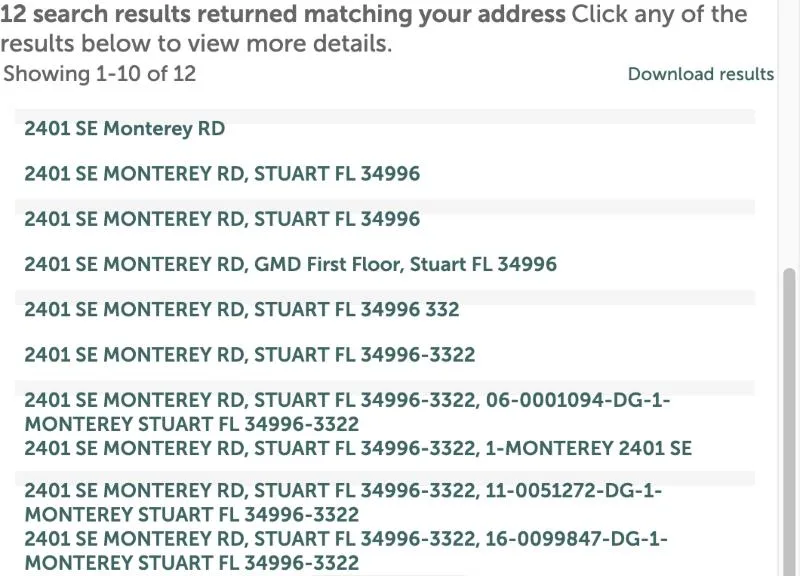
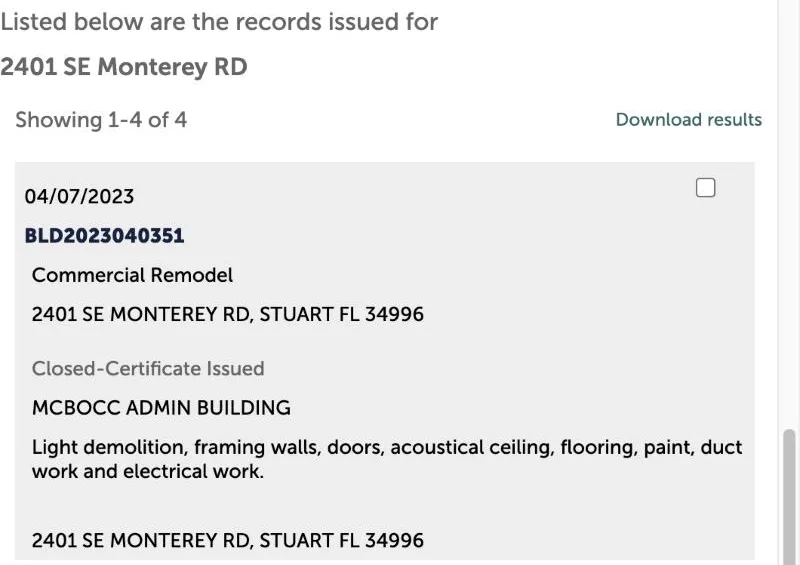
Opening all 12 address entries for the building one by one gave this:
| Address entry | What it opened |
|---|---|
| 2401 SE Monterey RD | 4 records, from 2010 to 2023 |
| 2401 SE MONTEREY RD, STUART FL 34996 | 3 records, without the 2010 roof |
| Two other entries | The 2010 roof record on its own |
| The remaining 8 | No records found |
Only one of the 12 entries held the full list, and it wasn't the one written like a mailing address. On a house, open every entry the search returns, write down the record numbers, and treat No records found as a dead end for that entry, not as news about the house. Accela's general screens are the same in other Florida counties; our Accela Citizen Access guide walks through them, and this page sticks to what is particular to Martin.
Martin's Accela search note gives one more useful trick: the % sign is a wildcard. If you have part of a record number from a seller's paperwork, put % on both sides of the digits you know.
How far back Martin County's online permits go
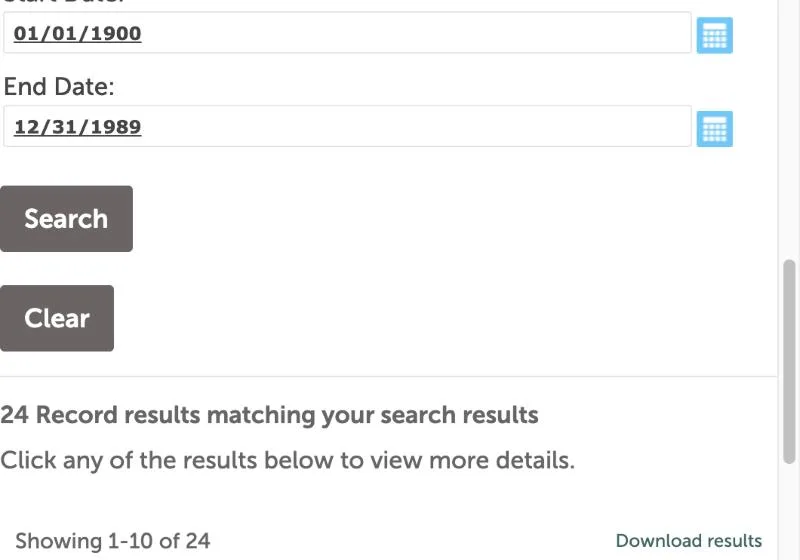
Martin County's Accela holds very few records from before 1990. A record search with the % wildcard and dates from 01/01/1900 to 12/31/1989 returned 24 records for the whole county. The year 1990 on its own returned 81, and 1991, 1995 and 2000 each filled the portal's 100+ display limit. The search form even starts its date box at 01/01/1990.
The 1990 cut-off matters because so much of Martin's housing is older than it. We matched Census figures for the county (American Community Survey, 2020 to 2024) to the date where the online record thins out:
| When the house was built | Share of Martin County housing units | Is the permit that built it likely to be in Accela? |
|---|---|---|
| Before 1980 | 33.5% | Unlikely |
| 1980s | 27.8% | Unlikely |
| 1990 to 2009 | 31.3% | It should be; open every address entry |
| 2010 or later | 7.4% | It should be |
Altogether, 61.3% of Martin County's 83,121 housing units were built before 1990, and the median year built is 1986. For about three in five homes, the permit that built the house probably isn't in the online search, even though later work on it, such as a reroof or an air-conditioner change-out, can be. The Census counts the whole county, towns included, and it records the year a house was built, not the year its permit was issued.
For the older file, Martin County's Building Department supplies copies of permit files, plans and surveys through the Request for Help or Information form on its records request page. Emailed copies are free, a disk is $1 and paper is priced by size. The county keeps building records under the state's GS1-SL retention schedule, so ask whether a file for the original construction still exists before you count on getting one.
What a Martin County permit status doesn't tell you
Martin County's records use status words that the county's permit-status page doesn't define. In our searches we saw Closed-Certificate Issued on the 2021 and 2023 records at the administrative center, Expired on a 2018 record described as a test, DONE on the 2010 reroof and on 8 of the first 10 records dated before 1990, and Closed-Cancelled on a 1989 siding permit.
The 2010 reroof, BRR2010040187, shows why the status line isn't enough. Its status is DONE. Open the record, though, and a yellow banner says it was placed on hold on 02/17/2018, under a condition labelled CITY-STU - STUART PROPERTY with a severity of Hold. The conditions list dates that hold 02/01/2018, eight years after the permit, and lists 13 other conditions as met. The portal doesn't say what the condition means, and we won't guess.
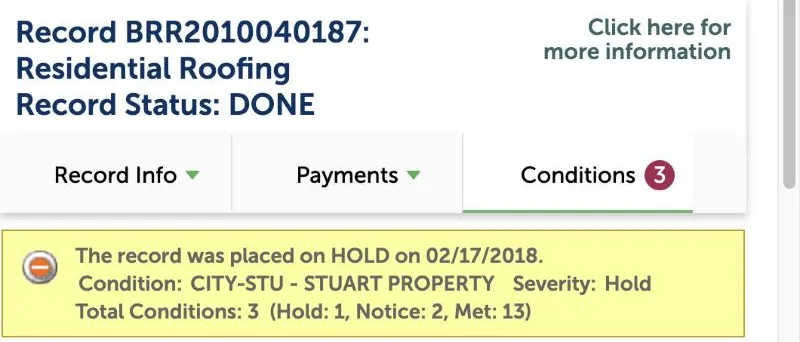
On any record for the house, open it and read the Conditions tab, not just the status. A hold or an unmet condition is a question for the Martin County Building Department at (772) 288-5916 before closing, and the answer is worth having in writing.
Since July 2026, some Martin County work has no permit to find
Martin County's page on HB 803 explains that from July 1, 2026, certain non-structural projects at a single-family house costing less than $7,500, materials and labor included, can be exempt from a permit. The exemption doesn't reach a property in a flood zone or flood hazard area, or any electrical, plumbing, mechanical, gas or structural work. Martin's examples of work that still needs a permit spell out that roofing, windows and doors, elevated decks and storage sheds count as structural, so a new roof or replacement windows still need one however cheap the job.
The exemption isn't automatic in Martin County. The owner or contractor has to get approval from the Building Department before the work starts, by sending a written Permit Exemption Application with documentation of the work and the signed contract with an itemized cost breakdown. The county is blunt about what happens next: "Work performed under an approved permit exemption will not be inspected by Building Department staff." The state rule behind it is Florida Statutes section 553.79(1)(g), from Chapter 2026-63.
We found no exemption among the 132 Building record types that Martin's public search offers, so an approved exemption may not show up in Accela at all. If the seller did cosmetic work after July 2026 and there's no permit for it, ask for the approved exemption application and the contract that went with it.
Martin County liens are a separate search
Martin County handles lien searches through Orange Data, not Accela. The county's lien page says every lien search request goes through the Orange Data Portal, which asks you to register, and that lien payoffs are paid to the county. A clean permit search says nothing about code liens, and a lien search isn't a permit history, so a buyer needs both.
If the Accela search turns up a permit that was never closed, Florida law lets the current owner deal with it. Under Florida Statutes section 553.79(16)(a), any owner of the property, whether or not they're named on the permit, can close it, keeping the original contractor or hiring a different licensed one. Our guide to resolving open permits before closing covers how to get that done before the sale, and the general method for looking up permits by address applies when the house turns out to be in one of the towns.
What Martin County Is Permitting Right Now
Martin County's permit total is up 148%, 711 units to 1,763, and most of that jump is apartments: multifamily went from 2 units to 924. Single-family permits, the line that compares with buying an existing house, are up 18.3%, from 709 to 839 homes. The Census count covers the whole county, Stuart and the other towns included, so it reaches beyond what the county's Accela portal holds.
Source: US Census Bureau Building Permits Survey, county file, year to date through September 2026 against the same months of 2025. 100% of these units were reported directly by permit offices; the rest are Census estimates for offices that did not report.
How we checked this
On 20 November 2026 we searched Martin County's Accela Citizen Access portal without an account, using the county's administrative center at 2401 SE Monterey Rd, a public building owned by the county. We opened each of the 12 address entries and counted the records under each, opened the 2010 reroof record and its conditions, ran countywide record searches by date to see where the online record thins out, and read the list of Building record types. The screenshots are ours and show no personal names; the contractor details on the records were left out.
We read the county's permit-status, records-request, lien-search and HB 803 pages, the Property Appraiser's list of municipalities and the Town of Ocean Breeze's permitting page on the same day. The housing figures come from Census table B25034, which our own script maps onto these date ranges. We read section 553.79 of the Florida Statutes on 17 November 2026.
What we couldn't check: the Stuart, Sewall's Point, Indiantown and Jupiter Island websites didn't load from our location; the portal doesn't explain the Stuart property hold; we didn't register for Orange Data, so we haven't seen a Martin lien report; and we don't know whether approved exemptions are recorded anywhere a buyer can search.