Purchasing a home clad in Exterior Insulation and Finish Systems (EIFS)—commonly known as synthetic stucco—without dedicated moisture testing can expose buyers to catastrophic structural framing decay hidden beneath an apparently pristine wall surface. Remediation costs for water-damaged synthetic stucco homes frequently reach tens of thousands of dollars, making pre-purchase evaluation one of the most critical steps in the due diligence process.
While synthetic stucco offers excellent insulation values and a sleek, modern architectural aesthetic, its tendency to trap moisture behind exterior panels requires specialized investigation. Relying solely on a general home inspector to verify the integrity of an EIFS wall assembly is one of the most common—and expensive—mistakes prospective home buyers make.
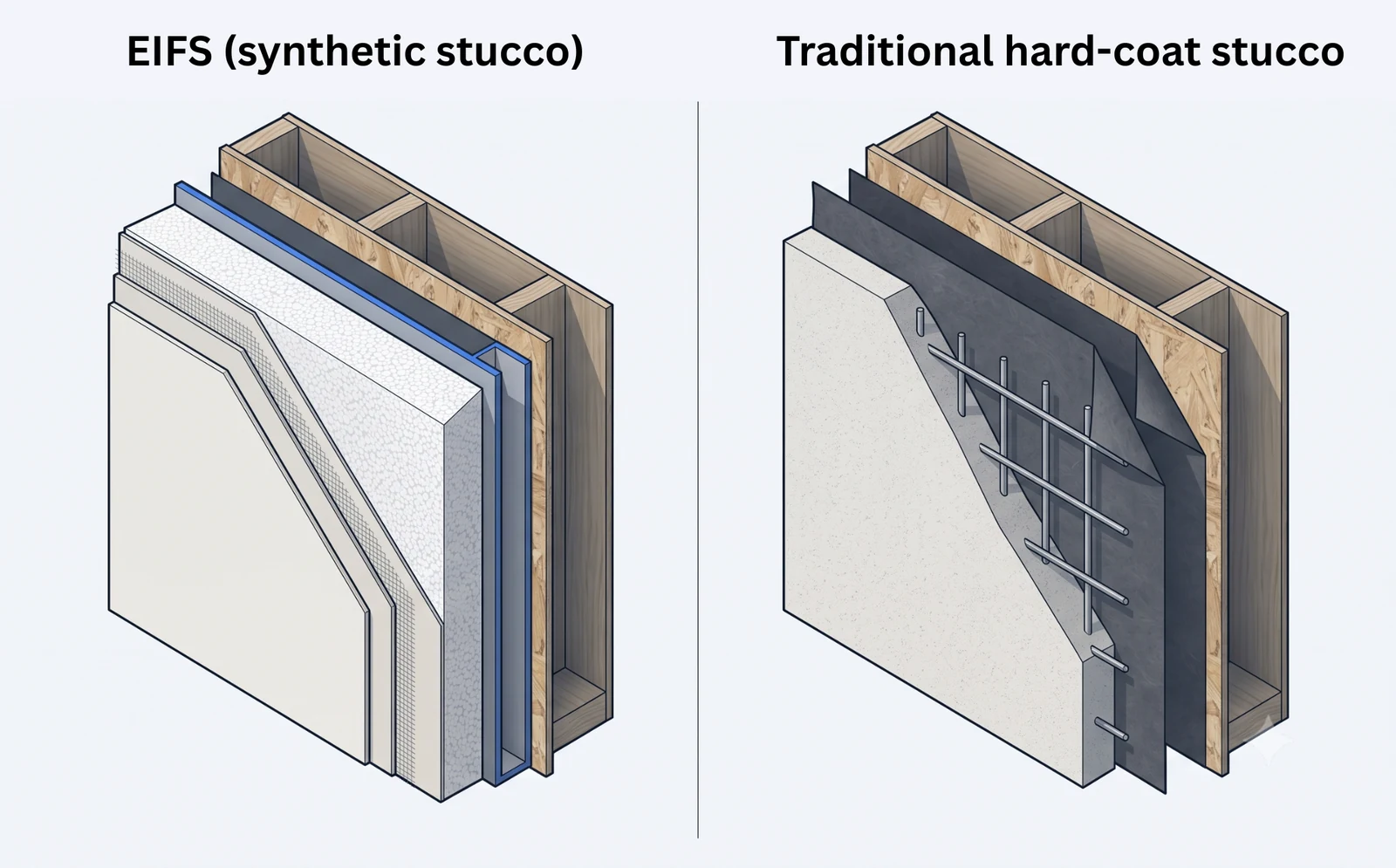
Free to use with credit (CC BY 4.0)
You can use this diagram on your own website, in an inspection report or in training material, including commercially. The one condition is credit to Before Regret as the source. License terms
Or download the image and credit it as “Diagram: Before Regret” with a link to this page.
Why Standard Home Inspections Skip EIFS Moisture Testing
A standard home inspection is designed as a non-invasive, visual examination of a property's accessible systems and components [ASHI]. General inspectors walk the perimeter, observe the exterior wall covering, and look for visible cracks, soft spots, or obvious staining. However, synthetic stucco is engineered to look seamless and water-resistant on the outside, even when the structural sheathing behind it is saturated and decaying.
Because evaluating moisture intrusion behind synthetic stucco requires inserting probe meters directly through the synthetic finish into the underlying substrate, it falls outside the scope of a standard inspection. General inspectors are prohibited by their professional standards of practice from performing invasive testing or damaging building finishes without explicit authorization.
General home inspectors typically lack the specialized certification, calibrated moisture detection equipment, and advanced training required to accurately evaluate EIFS wall assemblies. A general inspector may note that the home has synthetic stucco and recommend further evaluation, but they will rarely provide a definitive assessment of moisture levels behind the cladding.
The Mechanics of Synthetic Stucco: Barrier vs. Water-Managed Systems
To understand why moisture gets trapped behind EIFS, it helps to understand how wall assemblies are constructed. Synthetic stucco differs fundamentally from traditional hard-coat stucco, which is a heavy, cementitious plaster applied over metal lath. EIFS is a multi-layered exterior cladding system composed of several distinct components:
- Substrate: Structural sheathing, typically oriented strand board (OSB) or exterior-grade plywood attached to the wood framing studs.
- Insulation Board: Expanded polystyrene (EPS) foam board glued or mechanically fastened to the substrate.
- Base Coat: A synthetic polymer base coat applied over the foam board, embedded with fiberglass reinforcing mesh.
- Finish Coat: A textured, acrylic-based topcoat that provides color and weather resistance.
The vast majority of residential EIFS homes built during the peak installation era of the 1980s and 1990s utilized "barrier" EIFS. Barrier systems rely entirely on the outermost layer of sealant and finish coat to keep water out of the building envelope. They were designed under the assumption that water would never penetrate the outer skin.
In practice, water inevitably finds a path past the exterior seal through cracked sealant joints, unsealed window frames, deck flashings, or roof intersections. Once water gets behind barrier EIFS, it becomes trapped between the impervious foam board and the wood substrate. Unlike traditional soft-coat stucco, which is porous and allows moisture to evaporate outward, synthetic stucco acts as a vapor barrier [HUD]. Trapped moisture feeds wood-destroying fungi, leading to severe rot in stud walls, band joists, and subfloors without showing any visible signs on the exterior surface. Rot of that kind is what a pest inspector is actually looking for, and it is reported separately from the home inspection — the WDO report covers wood-destroying organisms, fungi included, not only insects.
Modern installations often use "water-managed" or "drainable" EIFS, which includes a drainage plane and a weather-resistive barrier behind the foam board to allow trapped water to drain down and escape at the bottom of the wall. However, determining whether a home features barrier or drainable EIFS—and whether a drainable system was installed correctly—requires specialized verification.
What an EIFS Stucco Evaluation Involves
A specialized EIFS moisture inspection goes far beyond a visual walkthrough. Certified EIFS inspectors follow standardized protocols established by industry organizations to evaluate the structural integrity of the wall assembly. A comprehensive EIFS inspection typically involves a multi-step process.
Visual and Thermal Scanning
The inspector begins with a thorough visual survey of all exterior walls, focusing on high-risk termination points, sealant joints, window and door perimeters, roof kick-out flashings, and deck attachments. Many certified inspectors also utilize high-resolution thermal imaging cameras. Infrared cameras do not measure moisture directly, but they detect subtle surface temperature variations caused by the evaporative cooling of trapped water behind the foam, helping the inspector target specific areas for physical probing.
Electronic Surface Metering
Before making any penetrations, the inspector uses non-invasive, radio-frequency moisture meters to scan the surface of the synthetic stucco. These surface meters generate a high-frequency field that penetrates the outer layers to detect potential high-moisture zones without damaging the finish coat.
Invasive Probe Testing
The definitive phase of an EIFS inspection involves probe testing using a calibrated moisture meter equipped with insulated deep-wall probes. The inspector drills two tiny holes—approximately one-eighth of an inch in diameter—through the synthetic stucco finish and foam insulation into the underlying wood sheathing at critical test points around windows, doors, penetrations, and wall bases.
The probes measure electrical resistance between the pins to determine the exact moisture content of the wood sheathing. At the same time, the inspector assesses the structural resistance of the substrate; if the probe pushes effortlessly into the wood without resistance, it indicates that the sheathing has rotted and lost structural integrity. After testing, the inspector seals each tiny probe hole with a color-matched, sealant compound designed specifically for synthetic stucco.
How to Read EIFS Evaluation Results
Moisture content in wood structural sheathing is measured as a percentage of dry wood weight. Understanding these numbers helps buyers evaluate the severity of any findings in an inspection report:
- Below 15% Moisture Content: Considered normal and dry. Wood sheathing in this range is structurally sound and free from active decay.
- 16% to 19% Moisture Content: Considered elevated. This range indicates that moisture is entering the assembly, but conditions may not yet have sustained fungal growth if the source is identified and repaired quickly.
- 20% to 28% Moisture Content: Considered wet. Wood sheathing in this range is vulnerable to active decay fungi, especially in warmer temperatures. Immediate investigation and repair are required.
- Above 28% Moisture Content: Saturated. Prolonged exposure at these levels leads to rapid wood decay, structural softening, and mold contamination. Substrate replacement is typically necessary.
In addition to moisture percentages, the inspector's physical assessment of sheathing hardness is critical. Elevated moisture in firm wood may simply require fixing a flashing detail and allowing the cavity to dry, whereas low moisture readings in soft, crumbling wood indicate historical water damage that has already destroyed the structural framing.
Exterior Red Flags Buyers Should Watch For
While a professional probe test is the only way to confirm substrate health, buyers viewing a home with synthetic stucco can watch for visual signs that suggest potential water intrusion and poor installation practices:
- Cracked or Missing Sealant Joints: Flexible sealant joints around window frames, door frames, and material transitions must be intact. Hardened, cracked, or missing caulk allows rainwater directly behind the foam.
- Missing Kick-Out Flashings: Where a roofline terminates against a vertical EIFS wall, a metal kick-out flashing must be installed to divert roof runoff into the gutter. Missing kick-out flashings are one of the leading causes of massive EIFS wall decay.
- Ground Clearance Violations: Synthetic stucco should terminate at least two inches above paved surfaces and six inches above exposed soil. EIFS buried beneath soil or mulch allows moisture to wick upward and creates unmonitored pathways for subterranean termites.
- Hard-Surface Contact: EIFS should never sit flush against unyielding surfaces like concrete patios, brick veneer, or wooden deck ledger boards without an expanding perimeter expansion joint.
- Staining and Efflorescence: Dark streaks below window corners or white, powdery mineral deposits along bottom edges indicate water weeping out of the wall assembly.
Home Insurance and Financing Considerations
Synthetic stucco issues extend beyond structural integrity; they can directly impact a buyer's ability to secure home insurance and mortgage approval.
Some insurance carriers maintain strict underwriting guidelines regarding barrier EIFS homes, particularly older installations built without drainage systems. Insurers may require a clean EIFS inspection report from a certified specialist before issuing a policy, or they may apply higher deductibles and specific exclusions for water damage related to synthetic stucco cladding.
Mortgage lenders may also freeze loan processing if a general inspector's report mentions synthetic stucco along with visual evidence of water damage, requiring a full specialist report and a clearance letter before clearing the loan to close.
Next Step for Home Buyers
If you are considering a home clad in synthetic stucco, do not rely solely on a standard visual home inspection to assess the building envelope. Contact a certified EIFS moisture inspector—typically certified through organizations such as the Exterior Design Institute (EDI) or the Moisture Warranty Corporation—to schedule a specialized probe inspection before your contractual inspection period expires.
If the specialized inspection reveals elevated moisture levels or soft sheathing, hire a licensed structural engineer or specialized stucco contractor to evaluate the extent of the framing damage and provide a comprehensive repair scope before removing your inspection contingencies.